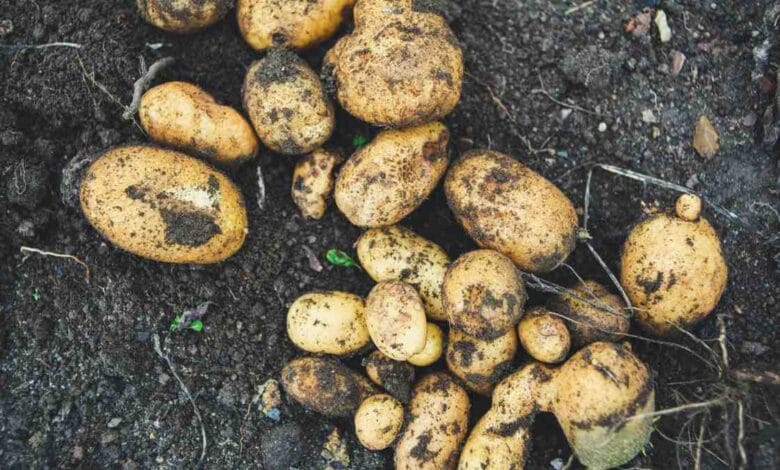
In the 2015 science fiction film The Martian, an astronaut stays alive by growing potatoes in a place where nothing should grow. That idea is now being tested in real life. Scientists are studying whether crops can grow in materials that act like lunar soil. This leads to a simple but important question. If the Moon has no air, no nutrients, and only dry dust, what would it take for a plant to survive there? The push for this research comes from plans to build long-term human bases on the Moon, where a steady food supply will be necessary.
Picture the Moon’s surface. It is covered in gray dust and rough rock, with no water and no natural life. Yet researchers are trying to grow potatoes in these conditions because future space missions may depend on it. Carrying food from Earth is expensive and limited, so growing food locally would make missions more sustainable and reduce supply risks. Potatoes are a strong candidate since they grow in many environments and provide essential nutrients. The goal is to see if they can adapt to soil that was never meant to support life. Researchers tested whether they can grow in materials that behave like lunar soil.
The Problem with Moon Soil
The Moon’s surface layer is called regolith. It is made of fine dust and rock fragments. It does not contain organic matter, which is necessary for plant growth on Earth. To study plant growth, scientists created lunar soil simulants. These are mixtures of crushed minerals and volcanic material that match the chemistry of lunar regolith.
When potatoes were grown in these simulants without any additions, the plants did not develop well. Growth was limited. The plants were smaller, with weak stems and poorly formed roots. In some cases, root systems were too small to measure clearly. This shows that regolith alone does not support plant growth. It lacks nutrients and structure needed for healthy development.
How Compost helps Plants Grow
Researchers added compost to the simulant to test whether organic material would improve growth. The compost used was vermicompost, produced from organic waste processed by worms. When about 5 percent compost was added, the plants began to grow. With a mixture of about 70 percent simulant and 30 percent compost, plant growth was closer to that seen in regular soil.
This result shows that organic material supports plant development in lunar-like soil. It improves nutrient availability and helps the soil hold water. Even with compost, the plants did not match the control group grown in Earth soil. They remained shorter and produced fewer potatoes. Yield reduction was consistent across tests.
Hidden Stress inside the Plants
Researchers studied how the plants responded at a biological level. They examined gene activity to understand how the plants handled the environment. The results showed increased activity in stress-related genes. These included genes linked to photosynthesis and internal metabolic processes. The plants were adapting to conditions that were not optimal. This indicates that even when growth occurs, the plants are under stress. They require more effort to maintain basic functions.
Are Moon-Grown Potatoes Safe to Eat?
The nutritional content of the potatoes was also tested. The results showed that key nutrients were mostly unchanged compared to potatoes grown in regular soil. However, the study found higher levels of certain heavy metals, especially copper and zinc, in potatoes grown in the simulant. These increases were linked to interactions between the soil material and added fertilizers. The study did not define whether these levels exceed safe limits for human consumption. Further testing is needed to determine food safety.
Challenges Beyond Soil
Soil composition is only one factor. The Moon has environmental conditions that were not included in these experiments. These include high radiation levels, lack of atmospheric pressure, and large temperature changes. The tests were done in controlled greenhouse conditions on Earth, so they do not fully represent the lunar environment. Lunar regolith also has physical properties that affect growth. It contains sharp particles that may damage roots. It compacts easily and does not drain water well. These factors can limit root development and water access.
What this Means for the Future
The experiments show that potatoes can grow in Moon-like soil if organic material is added. Growth is possible, but it is reduced compared to Earth conditions. In early lunar missions, farming directly in regolith may not be practical. Organic material would need to be added and managed over time. This could come from recycled biological waste in closed systems.
Future research may test different potato varieties and develop crops better suited to these conditions. Studies using actual lunar soil will also be required to confirm these findings. Potato growth in lunar-like soil is possible under controlled conditions with added compost. Further work is needed to address yield, safety, and environmental factors.
FAQs on Potatoes grow on the Moon
Q: Can potatoes really grow in Moon soil or lunar regolith?
A: Potatoes can grow in materials that behave like lunar soil, but not on their own. Studies show that plants only grow when organic compost is added to the soil. Without this addition, growth is weak, with poor roots and very low yield.
Q: Why is lunar soil not suitable for growing plants naturally?
A: Lunar soil does not contain organic matter, which is essential for plant nutrition and soil health. It also has poor structure, does not retain water well, and may contain sharp particles that affect root development. These factors make it difficult for plants to grow without modification.
Q: How does compost help potatoes grow in Moon-like soil?
A: Compost adds essential nutrients and improves the soil’s ability to hold water. In experiments, even a small amount of compost helped plants start growing. Higher compost ratios led to better plant development, though still not equal to Earth soil conditions.
Q: Are potatoes grown in lunar soil safe to eat for humans?
A: Research shows that the nutritional content of these potatoes remains mostly unchanged. However, there is an increase in certain heavy metals like copper and zinc. More studies are needed to confirm whether these levels are safe for regular consumption.
Q: Why are scientists trying to grow food like potatoes on the Moon?
A: Scientists are preparing for long-term space missions where astronauts cannot rely only on food from Earth. Growing crops on the Moon would make missions more sustainable and reduce dependence on supply deliveries. It is a key step for building permanent human bases.
Q: How do potatoes grown in lunar soil compare to those grown on Earth?
A: Potatoes grown in lunar-like soil are generally smaller and produce fewer tubers. Even with compost, their growth does not fully match plants grown in natural Earth soil. However, their basic nutritional value remains similar.
Q: What are the biggest challenges of farming on the Moon?
A: Major challenges include lack of nutrients in soil, poor water retention, and possible heavy metal buildup. In addition, factors like radiation, extreme temperatures, and lack of atmosphere make farming more complex. These conditions were not fully tested in current experiments.
Q: Will astronauts be able to grow their own food on the Moon in the future?
A: It is possible, but only with controlled systems and modified soil. Organic waste may be recycled into compost to support plant growth over time. Early missions will likely still depend on food from Earth while local farming systems improve.
Q: Why are potatoes chosen for space farming experiments?
A: Potatoes are easy to grow, produce a high amount of food, and contain important nutrients. They can adapt to different environments better than many other crops. This makes them a practical choice for testing space agriculture methods.
External Sources
- Handy D, Loeffler A, Knudson M, Campbell S, Jaiswal P, Anderson JC, Goyer A. Growth and molecular responses of potato to lunar regolith simulants. bioRxiv. 2026 Feb 24:2026-02. PrePrint. Doi: 10.64898/2026.02.23.707481.
- Fackrell LE, Humphrey S, Loureiro R, Palmer AG, Long-Fox J. Overview and recommendations for research on plants and microbes in regolith-based agriculture. npj Sustainable Agriculture. 2024 Sep 12;2(1):15. Doi: 10.1038/s44264-024-00013-5.
- Ming DW, Henninger DL. Use of lunar regolith as a substrate for plant growth. Advances in Space Research. 1994 Nov 1;14(11):435-43. Doi: 10.1016/0273-1177(94)90333-6.
- Madison A, Landsman Z, Long-Fox J, Metke A, Krol K, Easter P, Sipe C, Weber L, Britt D. Lunar dust simulants and their applications. In: Earth and Space. 2022 (pp. 86-94).
Disclaimer:
Some aspects of the webpage preparation workflow may be informed or enhanced through the use of artificial intelligence technologies. While every effort is made to ensure accuracy and clarity, readers are encouraged to consult primary sources for verification. External links are provided for convenience, and Honores does not endorse, control, or assume responsibility for their content or for any outcomes resulting from their use. The author declares no conflicts of interest in relation to the external links included. Neither the author nor the website has received any financial support, sponsorship, or external funding. This content is for informational purposes only and is not medical advice. Please consult a qualified physician before making health decisions. Images are for representational purposes only. Photo by Markus Spiske on Unsplash.