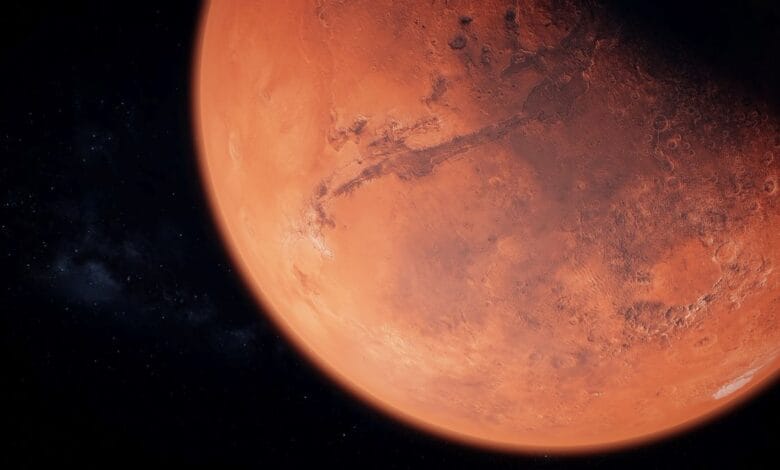
Humans are exploring the possibility of living on Mars for several reasons. Mars is the most Earth‑like planet in the solar system, with a similar day length and seasonal cycles. While many imagine astronauts walking into ready‑made buildings, the real challenge is creating those structures. Transporting construction materials from Earth is costly and risky, as every kilogram adds fuel needs and expense. This has led scientists to ask a critical question: can explorers use Mars’ own materials to build habitats and infrastructure on the planet?
This question has led researchers to explore some unusual ideas. One of them involves bacteria. These tiny living organisms already help humans in many ways on Earth, from making food to cleaning waste. Now, scientists are studying whether certain bacteria could help turn loose Martian soil into solid building material. A recent experimental study published in PLOS ONE looked closely at this possibility. The researchers focused on a natural process called microbial induced mineral precipitation. On Earth, this process has been studied for strengthening soil and repairing cracks in concrete. The idea is simple in concept. Some bacteria can produce minerals as part of their normal life processes. These minerals can act like glue between grains of soil.
The team studied bacteria that produce calcium carbonate. Calcium carbonate is the same material found in limestone and chalk. When these bacteria are given the right nutrients and a source of calcium, they trigger chemical reactions that cause mineral crystals to form. These crystals grow between soil particles and slowly bind them together. To see whether this could work for Mars, the researchers did not use real Martian soil. Actual samples from Mars are extremely rare. Instead, they used a laboratory made soil designed to closely match Martian regolith. Regolith is the loose, dusty material that covers the surface of Mars. The simulant used in the study had similar particle size, basalt rich composition, and chemical behavior.
In the laboratory, the scientists mixed the bacteria into this Mars like soil along with carefully measured nutrients and calcium. The samples were kept under controlled conditions that matched typical Earth laboratory environments. Over days and weeks, the researchers tested how the soil changed. The results showed a clear difference. Soil samples treated with bacteria became stronger than untreated samples. Tests measured compressive strength, which is how much pressure a material can withstand before breaking. Some treated samples reached strength levels similar to low grade concrete used for simple construction tasks on Earth.
Microscopes helped explain why this happened. The scientists saw networks of calcium carbonate crystals forming between individual soil grains. These crystals acted like bridges, locking the grains together. This mineral bonding increased stability and reduced the tendency of the soil to crumble. The researchers emphasized that this was an early stage experiment. The number of samples was limited, and everything took place in a laboratory. Still, the results showed proof that biologically driven soil strengthening could work using materials similar to those found on Mars.
One serious challenge the team addressed was the presence of perchlorates. Perchlorates are chemical salts known to exist widely in Martian soil. These substances are toxic to many living organisms, including bacteria. To test this problem, the researchers added perchlorates to some soil samples. When perchlorates were present, bacterial activity decreased. The bacteria produced fewer mineral bonds, and the soil did not become as strong. However, the process did not stop completely. Even with perchlorates, some mineral formation still occurred. This suggested that certain bacteria might tolerate low levels of these salts, although efficiency was reduced. This finding shows both potential and limitation. For large scale construction on Mars, scientists might need specially engineered bacteria or methods to remove or neutralize perchlorates from the soil. Each option would add complexity and energy costs.
Coverage of the study by The Daily Galaxy highlighted why this research matters. If future missions could rely on bacteria to help produce building materials on Mars, astronauts would not need to carry as much construction material from Earth. This idea fits into a broader strategy known as in situ resource utilization, which means using local resources instead of imported ones. Organizations like NASA have long identified in situ resource utilization as essential for long term human missions to Mars. Current projects already explore making oxygen from Martian carbon dioxide and producing fuel from local materials. Using biology to assist with construction would extend this approach to habitats and infrastructure.
Despite the promise, the researchers were careful not to overstate their results. The experiments did not simulate Mars gravity, surface radiation, thin atmosphere, or extreme temperature swings. Mars is far harsher than a laboratory incubator. Radiation is one of the biggest problems. Mars does not have a strong magnetic field like Earth, so its surface is exposed to high levels of cosmic radiation. Many bacteria would struggle to survive in such conditions. Any real application would likely need to take place underground, inside shielded reactors, or within pressurized structures.
Water is another major concern. Microbial induced mineral precipitation requires liquid water. Water exists on Mars mainly as ice beneath the surface. Extracting, melting, and transporting this water would require significant energy. Scientists still need to determine whether the energy savings from using local soil would outweigh the energy needed to obtain water. From a materials science perspective, the strength values measured in the study are early benchmarks. Buildings on Earth must meet strict safety and reliability standards. Materials must behave the same way every time. Achieving that level of consistency with living systems would require tight control over bacterial growth, nutrient delivery, and environmental conditions.
There are also planetary protection issues. Bringing Earth based microbes to Mars risks contaminating environments that scientists want to study for signs of past or present life. International rules limit biological contamination, and any use of bacteria for construction would have to follow strict guidelines. Even with these challenges, experts see this research as part of a larger shift. Scientists are increasingly combining biology and engineering instead of treating them as separate fields. Living systems can adapt, repair themselves, and operate with relatively low energy. These traits are valuable for remote and extreme environments like Mars.
It is noted that similar bacterial processes have already been used on Earth to stabilize sand, repair stone monuments, and strengthen foundations. Applying those lessons to Mars will take many years of testing, including experiments that better simulate Martian gravity and atmosphere. For now, the study adds an important idea to the discussion. It suggests that Martian soil might be more than an obstacle. With the help of biology, it could become a usable resource. Whether this approach will ever support full human settlements remains uncertain.
As Mars mission plans extend further into the future, studies like this expand the range of options available to engineers and scientists. Even if bacteria never become the main builders on Mars, understanding how they interact with extraterrestrial materials could improve construction strategies in space. Turning laboratory experiments into working technology will require collaboration across microbiology, materials science, aerospace engineering, and planetary science. The study does not claim to solve the problem of building on Mars. It shows that the problem may have more possible solutions than once thought.
FAQs on Bacteria Build Structures on Mars
Q: Can bacteria really survive on Mars long enough to build structures?
A: Most known bacteria would struggle to survive directly on the Martian surface due to radiation, cold, and low air pressure. The study only tested bacterial activity under Earth laboratory conditions using Mars like soil. Any future use would likely involve protected environments such as sealed reactors or underground spaces with shielding and temperature control.
Q: How strong is bacteria formed biocement compared with concrete?
A: The strongest samples approached the strength of low grade concrete used for simple construction on Earth. However, these results came from small laboratory samples with controlled conditions. Conventional concrete offers far greater consistency and reliability, which bacterial biocement does not yet provide.
Q: Why is perchlorate a problem for bacterial construction on Mars?
A: Perchlorates are toxic salts commonly found in Martian soil. They interfere with bacterial metabolism and reduce mineral formation. In the study, higher perchlorate levels lowered efficiency, showing that this chemical challenge must be addressed before any practical use.
Q: Can astronauts build homes using bacteria on Mars?
A: No. The research demonstrates a laboratory concept rather than a ready technology. Safe human habitats require materials that meet strict engineering standards. Bacteria might contribute to future construction methods, but they are not expected to replace traditional systems.
Q: How does this approach compare with other Mars construction ideas?
A: Other ideas include melting soil with microwaves, 3D printing structures, and assembling prefabricated habitats. Bacterial methods may require less energy in theory but depend heavily on water and biological control. Each approach has advantages and limitations.
External Sources
- Dubey S, Shukla S, Gupta N, Dixit R, Bhadury P, Kumar A. Effect of perchlorate on biocementation capable bacteria and Martian bricks. PLoS One. 2026 Jan 29;21(1):e0340252. Doi: 10.1371/journal.pone.0340252.
- Dikshit R, Gupta N, Kumar A. Microbial Endeavours Towards Extra-terrestrial Settlements: R. Dikshit et al. Journal of the Indian Institute of Science. 2023 Jul;103(3):839-55. Doi: 10.1007/s41745-023-00383-8.
Disclaimer:
Some aspects of the webpage preparation workflow may be informed or enhanced through the use of artificial intelligence technologies. While every effort is made to ensure accuracy and clarity, readers are encouraged to consult primary sources for verification. External links are provided for convenience, and Honores does not endorse, control, or assume responsibility for their content or for any outcomes resulting from their use. The author declares no conflicts of interest in relation to the external links included. Neither the author nor the website has received any financial support, sponsorship, or external funding. Image by Daniel Roberts from Pixabay.