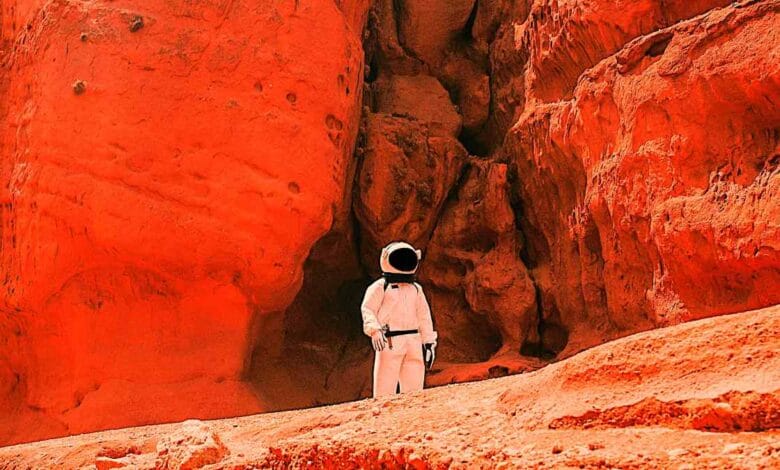
Movies and novels often show humans living on Mars. In these stories, astronauts build small settlements, grow food, and slowly transform the planet into another home for humanity. This idea appears frequently in science fiction. Scientific research presents a different picture. Planetary scientists and space medicine researchers describe Mars as a hostile environment for human life.
Survival on Mars may be technically possible, but it would require advanced technology. Humans would need sealed habitats, strong radiation protection, and constant life support systems. Instead of open towns like those seen in films, early human bases would likely operate as tightly sealed research stations. Examining the real conditions on Mars shows why scientists approach the idea of colonization cautiously.
The Harsh Environment of the Red Planet
The atmosphere on Mars is the first major obstacle. Mars has about one percent of Earth’s atmospheric pressure. The atmosphere is made mostly of carbon dioxide, which humans cannot breathe. A person standing on the surface without a pressurized spacesuit would lose consciousness quickly because there is not enough oxygen or pressure to support human life.
Temperature is another challenge. The average temperature on Mars is around minus eighty degrees Fahrenheit. These conditions are colder than most environments on Earth. Scientists sometimes compare the climate to Antarctica combined with the vacuum of space. For this reason, astronauts would need sealed habitats that maintain air pressure, oxygen levels, and safe temperatures. Some researchers suggest building these habitats underground. Soil and rock above the structure could help block harmful radiation.
Radiation is one of the most serious risks on Mars. Earth is protected by a magnetic field and a thick atmosphere that block many high energy particles from space. Mars does not have these protective layers. Because of this, astronauts on Mars would be exposed to radiation from the Sun and from cosmic sources in deep space. Long term exposure can damage DNA and increase the risk of cancer.
The soil on Mars creates another problem. Martian soil contains chemicals called perchlorates. These salts are toxic to humans if they enter the body and can interfere with thyroid function. This means crops could not be safely grown in untreated Martian soil.
Challenges the Human Body Would Face
Travel to Mars takes a long time. A full mission that includes travel and work on the planet could last about three years. During the journey, astronauts would spend many months in microgravity. After arriving on Mars, they would live in weaker gravity than on Earth. Mars has about thirty eight percent of Earth’s gravity. Human bodies developed under Earth’s gravity. Long periods in reduced gravity affect muscles and bones. Research on astronauts shows bone density can decrease by about one to one and a half percent per month without countermeasures. Lower gravity also changes how blood moves through the body. It can affect balance and cardiovascular function. Astronauts returning from long missions sometimes experience dizziness or difficulty standing while their bodies adjust again to Earth’s gravity.
Psychological stress is another concern during Mars missions. A small crew would live millions of kilometers away from Earth. Communication delays between Mars and Earth can reach twenty minutes each way. Astronauts would live in confined spaces for long periods with limited contact with family and friends. Researchers studying long duration spaceflight identify isolation and confinement as potential sources of mental strain.
Food production on Mars would also be difficult. Science fiction often shows astronauts growing crops in large domes on the surface. In practice, weak sunlight, toxic soil, and limited water supply make traditional farming difficult. Because of this, most proposed systems rely on hydroponic agriculture. Hydroponics grows plants in water that contains nutrients instead of soil. These systems operate inside controlled habitats where light, temperature, and nutrients can be regulated.
Even with these technologies, early missions to Mars are expected to focus on research and exploration rather than permanent settlement. Supporting astronauts for limited missions inside controlled habitats is more achievable than building a self sustaining colony. Mars remains an important target for scientific exploration. Current research shows that living there would require extensive technology, environmental protection, and medical support.
FAQs on Why Living on Mars is Harder
Q: Can humans really live on Mars?
A: Humans could potentially live on Mars, but only with advanced technology. Astronauts would need sealed habitats, life support systems, and protection from radiation. Current research suggests that short term missions may be possible, but permanent settlements would be much more difficult.
Q: Is Mars considered a dangerous place for humans?
A: Mars has a very thin atmosphere made mostly of carbon dioxide, which humans cannot breathe. The planet is also extremely cold and lacks the protective magnetic field that Earth has. These conditions expose astronauts to radiation, low pressure, and other environmental risks.
Q: Would astronauts need special suits to survive on Mars?
A: Yes, astronauts would need pressurized spacesuits whenever they leave their habitats. The suits provide oxygen, maintain body pressure, and protect astronauts from the cold and radiation. Without a spacesuit, a human could not survive in the Martian environment.
Q: How cold is Mars compared to Earth?
A: The average temperature on Mars is around minus eighty degrees Fahrenheit. Some regions can become even colder, especially during the night. These temperatures make it impossible for humans to survive outdoors without protective equipment.
Q: Why is radiation a big problem on Mars?
A: Mars does not have a strong magnetic field or thick atmosphere like Earth. Because of this, harmful cosmic radiation and solar particles can reach the surface more easily. Long term exposure to this radiation can damage cells and increase the risk of diseases such as cancer.
Q: How long would a mission to Mars take?
A: A full mission to Mars could last about three years. This includes the travel time to reach the planet, the stay on the surface, and the return trip to Earth. Astronauts would spend many months in space before even arriving on Mars.
Q: How does low gravity on Mars affect the human body?
A: Mars has only about thirty eight percent of Earth’s gravity. Living in reduced gravity can cause muscles to weaken and bones to lose density over time. Astronauts must exercise regularly during space missions to help reduce these effects.
Q: Can astronauts grow food on Mars?
A: Growing food on Mars is possible, but it would need special systems. The soil on Mars contains toxic chemicals called perchlorates, which make normal farming difficult. Scientists suggest using hydroponic systems that grow plants in nutrient rich water inside controlled habitats.
Q: Would people live underground on Mars?
A: Some scientists believe underground habitats could help protect astronauts from radiation. Layers of Martian soil and rock could act as natural shielding. Underground bases could also help maintain stable temperatures and air pressure.
Q: Will Mars ever become a second Earth?
A: Turning Mars into a planet like Earth would require a process called terraforming. This would involve changing the atmosphere, temperature, and water systems of the entire planet. Most scientists believe this would be extremely difficult with current technology.
External Sources:
- Patel ZS, Brunstetter TJ, Tarver WJ, Whitmire AM, Zwart SR, Smith SM, Huff JL. Red risks for a journey to the red planet: The highest priority human health risks for a mission to Mars. npj Microgravity. 2020 Nov 5;6(1):33. Doi: 10.1038/s41526-020-00124-6.
- NASA. The Human Body in Space. NASA Human Research Program. Available from: https://www.nasa.gov/humans-in-space/the-human-body-in-space/
- NASA. Real Martians: How to protect astronauts from space radiation on Mars. Available from: https://www.nasa.gov/science-research/heliophysics/real-martians-how-to-protect-astronauts-from-space-radiation-on-mars/
- NASA Human Research Program. Five hazards of human spaceflight. Available from: https://www.nasa.gov/hrp/hazards/
Disclaimer:
Some aspects of the webpage preparation workflow may be informed or enhanced through the use of artificial intelligence technologies. While every effort is made to ensure accuracy and clarity, readers are encouraged to consult primary sources for verification. External links are provided for convenience, and Honores does not endorse, control, or assume responsibility for their content or for any outcomes resulting from their use. The author declares no conflicts of interest in relation to the external links included. Neither the author nor the website has received any financial support, sponsorship, or external funding. Photo by Nicolas Lobos on Unsplash.