Earthquakes are among the most destructive natural disasters on Earth. In just a few seconds, violent ground shaking can collapse buildings, destroy roads, and change entire landscapes. Every year, the planet experiences about 20,000 earthquakes, though only a few hundred cause damage. Still, powerful quakes have taken hundreds of thousands of lives and displaced millions of people throughout history. For a long time, scientists believed earthquakes were caused only by forces deep inside the Earth. Huge tectonic plates slowly push against each other. Pressure builds along cracks in the crust called faults. When the pressure becomes too strong, the rock suddenly breaks and the ground shakes. This process explains most earthquakes around the world.
But recently, some researchers started asking an interesting question. Could events happening far away in space slightly affect when earthquakes occur on Earth? A new geophysical study explores whether solar storms might influence the timing of some earthquakes. The idea is still being tested, but the research has opened a new discussion among scientists.
When Solar Storms Reach Earth
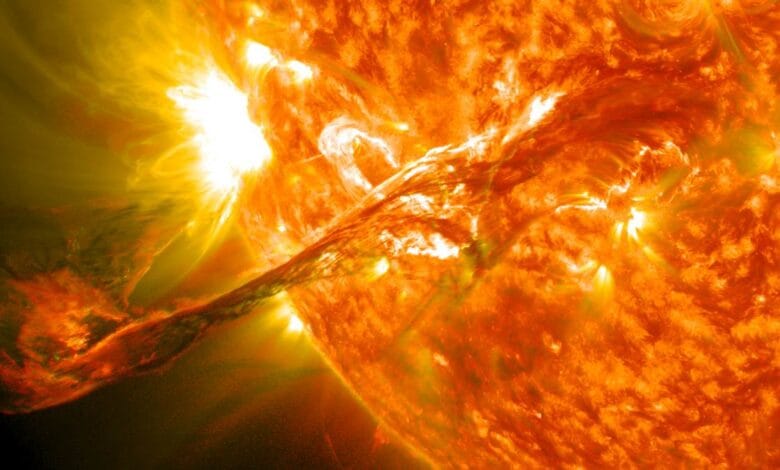
The Sun is not always calm. Sometimes it releases huge bursts of energy and charged particles. These events are called solar storms. They often happen after solar flares or coronal mass ejections, which send streams of plasma racing through space. When these energetic particles reach Earth, they interact with our planet’s magnetic field. This interaction can create geomagnetic storms. These storms can disturb satellites, affect radio communication, and produce beautiful auroras near the poles.
Scientists already know that strong geomagnetic storms can cause electrical currents in power lines and pipelines. Now researchers are exploring whether similar electrical effects might also occur in the Earth’s crust. To study this possibility, scientists compared two sets of data. One set showed records of solar activity and geomagnetic disturbances. The other included earthquake catalogs collected from around the world. When researchers studied the information closely, they noticed something interesting. Some powerful earthquakes seemed to happen shortly after peaks in geomagnetic activity. These peaks often appeared during or after solar storms. The pattern did not look completely random. This observation encouraged scientists to investigate further.
Could Solar Storms Trigger Earthquakes
It is important to understand that scientists are not claiming solar storms create earthquakes from nothing. The main cause of earthquakes is still tectonic stress inside the Earth. However, faults are often already under enormous pressure. Many of them exist in a fragile state where they are close to breaking. In such situations, even small changes in stress might influence exactly when the rock finally slips. Researchers think geomagnetic storms could produce tiny electrical currents in the crust. These currents may move through conductive minerals, underground fluids, and fractured rock found along fault zones.
If electrical currents pass through these areas, they might create small electromagnetic forces. In theory, these forces could slightly change the stress inside the rock. Most of the time the effect would probably be too small to matter. But if a fault is already very close to rupture, even a tiny disturbance might act as a trigger. This idea is not completely new in earthquake science. Scientists already know that small stress changes can sometimes trigger earthquakes. For example, ocean tides caused by the Moon and the Sun can slightly change pressure on faults. Changes in underground fluid pressure can also influence seismic activity. Solar related electromagnetic effects could represent another possible trigger in certain situations.
Why Scientists are Still Careful
Even though the idea is interesting, researchers remain cautious. Finding a clear connection between solar storms and earthquakes is difficult. One reason is that earthquakes happen very often. Every year the Earth experiences thousands of them. Dozens of earthquakes larger than magnitude six occur annually. Because these events are so common, some earthquakes will naturally happen after solar storms by coincidence. To prove a real relationship, scientists must analyze very large datasets that cover many years. They also need to test whether the patterns appear consistently over time.
The recent study looked at earthquakes with magnitudes of 5.6 or greater and compared them with periods of strong geomagnetic activity. The researchers found several cases where earthquakes occurred soon after geomagnetic disturbances. This result suggests a possible link, but it does not confirm one. Seismologists have seen many proposed earthquake triggers in the past. Some early ideas looked promising but later studies showed the patterns were accidental. Because of this history, scientists treat new claims carefully until strong evidence appears.
Future research may help answer the question. Scientists plan to examine larger datasets that cover multiple solar cycles. A solar cycle lasts about eleven years, during which solar activity rises and falls. Modern monitoring tools may also help. Today researchers can measure magnetic activity, ground movement, and seismic signals with very precise instruments. By combining these observations, scientists may better understand whether solar activity plays any role in earthquake timing.
For now, tectonic forces remain the main driver of earthquakes. Solar storms, if they have any effect at all, would likely act only as small triggers for faults that are already close to breaking. The idea that space weather might interact with processes inside our planet reminds scientists that Earth is part of a much larger system. The Sun, the atmosphere, and the solid Earth all influence one another in complex ways. Understanding these connections may take many years of research, but each new study helps scientists learn a little more about how our dynamic planet works.
FAQs on Solar Storms Could Trigger Powerful Earthquakes
Q: Can solar storms trigger earthquakes on Earth?
A: Some researchers are exploring whether solar storms could influence the timing of certain earthquakes. The idea is that geomagnetic disturbances from solar activity might create small electromagnetic forces in Earth’s crust. However, scientists emphasize that tectonic stress remains the main cause of earthquakes and the connection is still being studied.
Q: How could solar activity affect earthquakes?
A: Solar storms can disturb Earth’s magnetic field and create geomagnetic storms. These disturbances may induce electrical currents in the Earth’s crust, especially in areas with conductive minerals and fluids. Researchers believe these currents could slightly change stress conditions along faults that are already close to breaking.
Q: Do solar storms directly cause earthquakes?
A: No evidence shows that solar storms directly cause earthquakes. Earthquakes mainly occur because tectonic plates move and build up stress along faults. Solar activity, if it has any role, would likely act only as a minor trigger for faults that are already near rupture.
Q: What is a solar storm and how does it affect Earth?
A: A solar storm occurs when the Sun releases bursts of energy and charged particles into space. When these particles reach Earth, they interact with the planet’s magnetic field and create geomagnetic disturbances. These storms can affect satellites, radio communications, power grids, and sometimes produce bright auroras in the sky.
Q: Have scientists found a pattern between solar storms and earthquakes?
A: Some studies have noticed that certain large earthquakes occurred shortly after periods of strong geomagnetic activity. These patterns suggest a possible connection, but they do not prove that solar storms triggered the earthquakes. Scientists need more data over longer time periods to confirm any real relationship.
Q: Why is it difficult to prove a link between solar storms and earthquakes?
A: Earthquakes happen frequently around the world, which makes coincidences possible. When thousands of earthquakes occur each year, some will naturally appear close in time to solar storms. Researchers must analyze large datasets and use careful statistical methods to determine if the pattern is real.
Q: Can solar storms help predict earthquakes?
A: At the moment, solar activity cannot be used to predict earthquakes. Scientists do not have reliable methods to forecast the exact time and location of seismic events. Even if solar storms influence earthquake timing slightly, they would affect only faults already near failure.
Q: Are there other external forces that can influence earthquakes?
A: Yes, small external forces can sometimes affect faults that are already under strong pressure. For example, tidal forces from the Moon and the Sun can slightly change stress levels in Earth’s crust. Changes in underground fluid pressure have also been known to trigger earthquakes in certain regions.
Q: What magnitude earthquakes were studied in the research?
A: The research mainly focused on earthquakes with magnitudes of 5.6 or greater. These stronger events are easier to track and analyze in global earthquake catalogs. By comparing them with records of geomagnetic activity, scientists looked for possible timing patterns.
Q: What future research is needed to confirm this theory?
A: Scientists need to analyze larger earthquake datasets covering multiple solar cycles, which last about eleven years. More detailed measurements of geomagnetic activity and crustal stress may also help clarify the relationship. Continued research will determine whether solar storms play any role in earthquake timing.
External Sources:
- Mizuno A, Kao M, Umeno K. Possible mechanism of ionospheric anomalies to trigger earthquakes – Electrostatic coupling between the ionosphere and the crust and the resulting electric forces acting within the crust. International Journal of Plasma Environmental Science and Technology. 2026; 20: e01003. Doi: 10.34343/ijpest.2026.20.e01003.
- Odintsov SD, Ivanov-Kholodnyi GS, Georgieva K. Solar activity and global seismicity of the earth. Bulletin of the Russian Academy of Sciences: Physics. 2007 Apr;71(4):593-5. Doi: 10.3103/S1062873807040466.
- Odintsov S, Boyarchuk K, Georgieva K, Kirov B, Atanasov D. Long-period trends in global seismic and geomagnetic activity and their relation to solar activity. Physics and Chemistry of the Earth, Parts a/b/c. 2006 Jan 1;31(1-3):88-93. Doi: 10.1016/j.pce.2005.03.004.
Disclaimer:
Some aspects of the webpage preparation workflow may be informed or enhanced through the use of artificial intelligence technologies. While every effort is made to ensure accuracy and clarity, readers are encouraged to consult primary sources for verification. External links are provided for convenience, and Honores does not endorse, control, or assume responsibility for their content or for any outcomes resulting from their use. The author declares no conflicts of interest in relation to the external links included. Neither the author nor the website has received any financial support, sponsorship, or external funding. Image credit: NASA Goddard Space Flight Center, CC BY 2.0, via Wikimedia Commons.