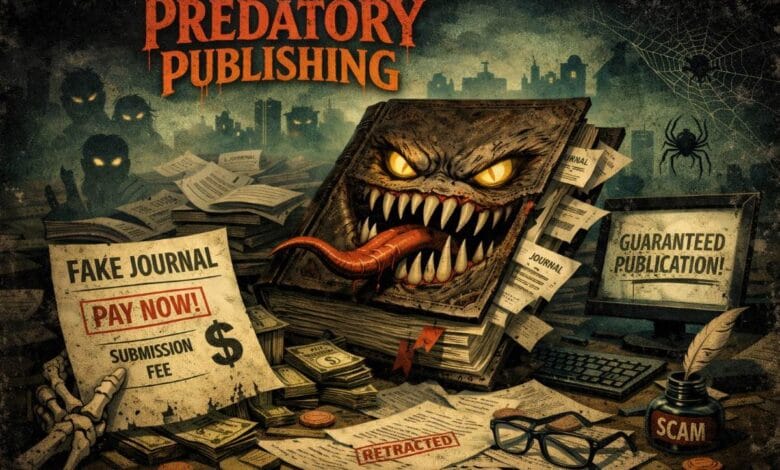
Academic landscape facing an insidious and growing challenge: predatory publishing. Journals and conferences exploit the “publish or perish” pressures that researchers encounter globally. While the concept of predatory publishing emerged nearly two decades ago, it has evolved with new technologies, including artificial intelligence, creating increasingly sophisticated traps for unsuspecting academics.
Predatory publishers often mimic legitimate journals, offering quick publication with minimal or no peer review. Researchers, particularly early-career academics, can inadvertently submit their work to these journals, risking reputational damage, wasted funding, and the propagation of unverified research. According to a recent report by Chemistry World, the number of suspicious journals flagged by automated tools has surged in the last five years, highlighting the urgency of coordinated action.
Predatory publishing is not just a nuisance; it undermines the credibility of science itself.
While some academics dismiss predatory journals as minor annoyances, the broader consequences are significant. From skewed citation metrics to compromised grant evaluations, these journals can distort the academic ecosystem. This article delves into the mechanisms of predatory publishing, its risks, emerging detection strategies, and practical guidance for researchers navigating this complex landscape.
Understanding Predatory Publishing
Predatory publishing refers to journals and conferences that prioritize profit over rigorous scholarly standards. They often advertise rapid publication, charge substantial fees, and claim a broad international presence, while providing little or no editorial or peer review.
Some common characteristics of predatory publishing include:
- Aggressive solicitation via spam emails targeting researchers.
- Lack of transparent editorial boards or inclusion of fictitious reviewers.
- Misrepresentation of indexing in reputed databases.
- Excessive fees with promises of fast-track publication.
A 2025 Nature analysis found that predatory publishers are increasingly using AI to generate or curate content, blurring the line between legitimate and fraudulent academic outlets. This technological evolution allows them to scale operations and expand their deceptive reach.
AI has become a double-edged sword; it enables efficient research, it also empowers predatory journals to mimic legitimacy more convincingly.
The consequences extend beyond wasted effort; entire research fields can be impacted by the infiltration of low-quality or fabricated studies. Academics, institutions, and policymakers must therefore understand not just the mechanics but the evolving sophistication of these journals.
Risks to Researchers and Academia
The dangers of predatory publishing are multi-layered. For individual researchers, the risks include:
- Reputation damage: Work published in predatory journals is often disregarded by peers, impacting career prospects and grant eligibility.
- Financial loss: Submission fees can be substantial, often exceeding thousands of dollars.
- Intellectual theft: Some journals exploit author submissions, republishing or misusing content.
Institutions, too, face repercussions. Predatory articles can affect university rankings, distort departmental metrics, and compromise the quality of student supervision. In one alarming example, a South American university reported over 120 faculty members unknowingly publishing in journals later identified as predatory, leading to a review of hiring and promotion criteria.
The ripple effects of predatory publishing extend far beyond the individual author.


Statistics reveal the scale of the problem. An AI screening tool cited in Nature flagged hundreds of suspicious journals in chemistry, life sciences, and social sciences alone in 2025, reflecting both growth in predatory activity and advances in detection.
AI Screening and Detection Tools
One promising approach to combat predatory publishing is the use of AI-driven screening systems. These tools analyze journal metadata, peer review histories, and publication patterns to identify suspicious practices. Features often assessed include:
- Unverified or absent editorial boards
- Unusually high acceptance rates
- Citation anomalies and unusual indexing claims
While AI detection is not foolproof, combining automated screening with human review significantly reduces the risk of falling prey to predatory outlets. Universities in North America and Europe are increasingly integrating such tools into library services, providing researchers with guidance before submission.
AI tools act as the first line of defense, but researcher vigilance remains essential.
Despite these advances, challenges remain. Predatory publishers adapt rapidly, modifying websites, editorial claims, and even citation metrics to bypass automated filters. Consequently, ongoing monitoring, training, and awareness campaigns are critical components of an effective defense strategy.
Red Flags and Strategies to Avoid Predatory Journals
Researchers can safeguard their work by recognizing common warning signs:
- Solicitations via email: Legitimate journals rarely cold-email unsolicited researchers.
- Promises of rapid publication: If it sounds too good to be true, it probably is.
- Opaque editorial boards: Verify credentials and affiliations.
- Misleading impact factors: Check reputable indexing databases like Scopus or Web of Science.
- High or upfront fees: Assess cost against journal legitimacy.
Additional strategies include consulting librarian-curated lists of verified journals, using institutional guidance, and seeking peer recommendations. Early-career researchers, in particular, should prioritize mentorship to navigate these decisions.
Knowledge of red flags is essential in identifying & avoiding predatory journals. Prevention is better than remediation.
Institutional and Global Policy Responses
Global efforts are underway to mitigate predatory publishing. Organizations like COPE (Committee on Publication Ethics) provide frameworks for ethical publishing and encourage transparency. Some universities have developed mandatory pre-submission checks and approvals, requiring researchers to submit prospective journals for review.
Governments and research councils are also weighing policy interventions, including:
- Formal warnings about predatory journals in funding guidelines
- Encouraging open-access repositories for legitimate research
- International collaboration to maintain verified journal registries
These policies not only protect researchers but also preserve the credibility and integrity of scientific output worldwide.
The fight against predatory publishing will be ongoing, but awareness, tools, and institutional support are powerful weapons.
Future Outlook and Challenges in 2026
Looking forward, predatory publishing is likely to remain a significant challenge, particularly with AI-assisted content creation. Emerging risks include:
- AI-generated papers mimicking peer-reviewed research
- Deepfake authorship claims
- Exploitation of open-access mandates for profit
Addressing these threats requires a combination of technology, policy, and researcher education. Ultimately, the responsibility lies with both individual academics and institutions to cultivate a culture of verification, transparency, and ethical practice.
Navigating the predatory publishing landscape requires vigilance, education, and proactive measures.
Conclusion
Predatory publishing remains a pervasive threat to academic integrity in 2026. By recognizing warning signs, leveraging AI detection tools, adhering to institutional policies, and fostering awareness among researchers, the academic community can protect both individual careers and the credibility of science.
FAQs for Predatory Publishing in 2026
1. What is a predatory journal?
A predatory journal is a publication that prioritizes profit over scholarly standards, often lacking proper peer review or editorial oversight.
2. How can researchers detect predatory journals?
Look for aggressive email solicitations, opaque editorial boards, unrealistic publication promises, unverified impact factors, and high fees.
3. Are early-career researchers more vulnerable?
Yes. Inexperienced academics often face pressure to publish quickly, making them susceptible to misleading journals.
4. Can AI tools reliably detect predatory journals?
AI screening can flag suspicious patterns but should be used alongside human verification for accuracy.
5. How do predatory journals affect academic careers?
Publishing in predatory journals can harm reputation, reduce funding opportunities, and impact promotion evaluations.
6. Are open-access journals always predatory?
No. Many reputable open-access journals follow strict peer-review protocols. Predatory journals exploit the open-access model for profit.
7. What institutional policies help prevent predatory publishing?
Pre-submission journal checks, researcher training, mentorship, and consultation with verified journal registries are effective measures.
8. How can I verify if a journal is legitimate?
Check inclusion in trusted databases (Scopus, Web of Science), review editorial boards, consult COPE guidelines, and use librarian-vetted lists.
External Sources
- Chemistry World. Report calls for urgent action to tackle predatory publishers. https://www.chemistryworld.com/news/report-calls-for-urgent-action-to-tackle-predatory-publishers/4015520.article
- University World News. Predatory publishing: Journals going rogue, authors beware! https://www.universityworldnews.com/post.php?story=20231213193936560
- Nature. Hundreds of suspicious journals flagged by AI screening tool. https://www.nature.com/articles/d41586-025-02782-6
- HeadTopics NG. The Predatory Publishing Trap: Navigating the Challenges Facing Academia in 2026. https://ng.headtopics.com/news/the-predatory-publishing-trap-navigating-the-challenges-77883534
- Committee on Publication Ethics (COPE). Ethical Guidelines. https://publicationethics.org/resources/guidelines
- Jeffrey Beall. “redatory Publishers and the Open Access Model. 2024. https://beallslist.net
- National Research Council Canada. Research and scientific integrity policy. https://nrc.canada.ca/en/corporate/values-ethics/research-scientific-integrity-policy
Disclaimer
This article is for informational purposes only. It does not constitute professional advice and should not replace consultation with institutional advisors or ethics boards. Some content on this page may have been created or reviewed with the help of artificial intelligence tools. While every effort is made to ensure reliability, readers are advised to consult primary sources. External links and references are offered for convenience, and Honores is not liable for their content or impact.