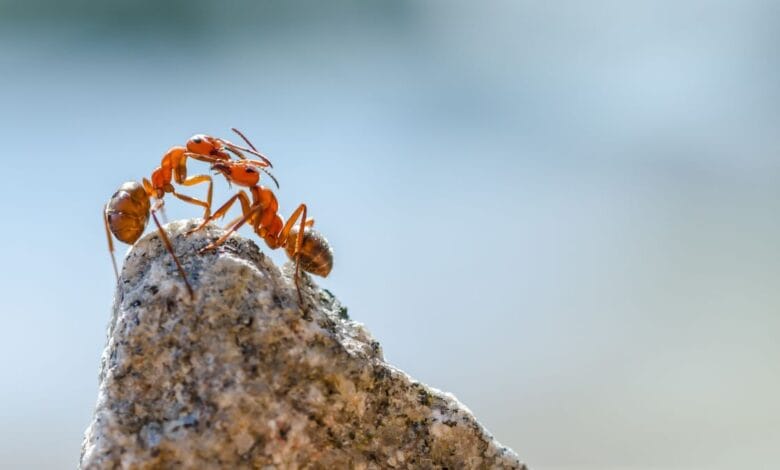
Imagine a busy ant city hidden beneath your feet. Thousands of ants rush through tunnels, carrying food, cleaning rooms, and caring for babies. No traffic lights to guide them. No leaders shouting orders. Still everything is in order because of the smell. Ants smell who belongs and who does not. For ants, smell is their language. Each ant carries a special scent on its body, like an invisible uniform. This scent tells other ants, “I am family. Do not attack me.” As long as that smell stays the same, the colony stays peaceful. But scientists have discovered something surprising. Dirty air can quietly scramble this scent and turn a calm ant nest into chaos.
Researchers wanted to know how air pollution affects insects, not by killing them, but by confusing them. They focused on ozone, a gas that forms on hot sunny days when pollution builds up in cities and industrial areas. Ozone is known for damaging human lungs, but what does it do to tiny creatures that live close to the ground? To find out, scientists studied six different ant species in the laboratory. They exposed some ants to ozone levels similar to what is sometimes measured during heavy pollution days. The ozone exposure lasted only twenty minutes. Then the ants were returned to their colonies.
That is when the trouble began. Ants that had breathed polluted air were suddenly treated like enemies. Their respective nest mates rushed at them, raised their bodies in threat poses, and even bit them. These were not strangers. They were sisters from the same colony. Yet the colony could no longer recognize them. To understand why this happened, we need to look closely at ant smells. An ant’s scent comes from a thin layer of chemicals on its outer shell. Most of these chemicals are simple and stable, but a small group of these chemicals plays a very important role in ant’s identity. These special chemicals help ants tell family from outsiders. Even tiny changes can make a big difference.
Ozone reacts easily with certain types of chemicals. When ants were exposed to ozone, it damaged the fragile parts of their scent. The change was extremely small, far too small for humans to notice. But for ants, it was like someone erased a few letters from a password. The smell no longer matched the colony record. The scientists confirmed this by using very sensitive instruments that measure chemicals in tiny amounts. After ozone exposure, previously recorded identity chemicals on the ants’ bodies dropped. The ants had not changed their behavior on purpose. Their chemical name tags had been altered by the air.
Five of the six ant species reacted with aggression toward ozone tested nest mates. The pattern was clear. More threats, more biting, more defensive behavior. The colony’s social rules were breaking down. One ant species behaved differently. This species reproduces in a special way. Every ant in the colony is almost genetically identical, like clones. Because of this, their scents are extremely similar. Even after ozone exposure, their colony members did not attack them. This exception gave scientists a chance to look at something else besides fighting. They exposed this specific ant species to ozone for longer periods and watched how they cared for their young. Ant larvae cannot survive without help. Adult ants must feed them, clean them, and keep them close. After prolonged exposure to ozone, the adults began to change. They stayed farther away from the larvae. They touched them less. Over time, many larvae died. The ozone did not poison the larvae directly. Instead, the adults seemed confused. Scientists believe the chemical signals that tell adults how to care for babies were disrupted.
This idea fits with earlier research on different insect species. Other studies have shown that ozone can damage pheromones used by flies to find mates. In some cases, males courted the wrong partners or failed to recognize their own species. These studies suggest that many insects depend on delicate chemical signals that pollution can disturb adversely. Ant colonies depend on learning smells early in life. When an ant hatches, it learns the colony scent and stores it like a memory. Later, when it meets another ant, it compares smells. If the difference is too large, the ant reacts with aggression.
At first, scientists thought ozone would not matter much. The identity chemicals make up only a small part of the overall scent. But the experiments showed the opposite. Even small chemical damage caused big social problems. Ant societies are finely tuned systems. Small errors can have large effects. Ants are ecosystem engineers. They dig tunnels that loosen soil. They spread seeds. They help control pests. When you add up all ants on Earth, their total weight rivals that of birds and mammals combined. Changes in ant behavior could ripple outward into forests, fields, and farms.
The scientists are careful not to overstate their findings. These experiments were done in controlled lab settings. Real ant colonies live in changing environments. Wind, rain, soil, and plants may reduce or change pollution exposure. Ants may also adapt over time. The ozone levels used in the study reached about one hundred parts per billion. These levels do occur during pollution spikes, especially near cities and highways. In extreme cases, ozone can go even higher for short periods. This means the exposures tested in the lab are realistic, but not constant year round.
Another challenge is that nature is complex. In the wild, ants face many stress factors at once. Pesticides, habitat loss, heat, and climate change all affect them. Air pollution may be one piece of a larger puzzle rather than the main cause of insect decline. Still, the study highlights something important. Environmental harm does not always show up as dead animals. Sometimes it shows up as broken communication. Most pollution rules focus on whether a substance causes illness or death. Much less attention is paid to whether pollution affects the behavior. But for social insects, behavior is survival. If ants attack their own family or neglect their young, the colony weakens even if no ant is immediately killed.
The researchers describe pollution as a kind of signal jammer. Chemical messages are the roads and bridges of insect societies. When ozone damages those messages, cooperation falls apart. Future studies will look at ants living outdoors to see how often these effects happen in real conditions. Scientists also want to know whether insects can adapt by changing their chemical signals or becoming less sensitive to damage. Another question is how multiple pollutants interact. Ozone rarely acts alone in the atmosphere.
The ant study tells a bigger scientific story. Tiny molecular changes can lead to large behavioral consequences. Air chemistry connects to biology in unexpected ways. A few damaged scent molecules can turn friends into enemies. This research does not claim that pollution is wiping out ant populations by itself. Instead, it shows a possible pathway by which polluted air can quietly destabilize social systems. Understanding that pathway is the first step toward protecting the hidden communities that keep ecosystems running. In the end, the lesson is simple but unsettling. Clean air matters not only for breathing lungs, but also for the invisible conversations that hold nature together.
FAQs for Pollution effects on Ant Colonies
Q: Is it true that pollution causes ants to attack nest-mates?
A: Yes. The evidence comes from controlled laboratory experiments that manipulated ozone exposure and observed resulting behaviors. Researchers demonstrated that ants exposed to ozone showed altered chemical profiles and increased aggression when reintroduced to their colonies.
Q: Why does changing an ant’s smell trigger aggression?
A: Ant colonies function through chemical recognition systems encoded in cuticular hydrocarbons. Ants compare incoming odors with learned colony templates. Small deviations can signal an intruder. Ozone chemically alters alkenes, molecules that contribute to colony identity signals. When these compounds degrade, nest-mates appear unfamiliar.
Q: Does this mean pollution is causing insect population decline?
A: The study demonstrates a mechanism through which pollution can disrupt social behavior. It does not measure population trends or long-term ecological collapse. Insect decline is multifactorial, involving habitat loss, pesticides, climate shifts, and other pressures. Air pollution may represent one contributing factor.
Q: Could similar pollution effects occur in bees or other social insects?
A: Many social insects rely on chemical communication systems similar to ants. Previous studies have shown ozone degrading pheromones in flies and interfering with pollinator behavior. These parallels suggest potential vulnerability across species.
Q: Are the ozone levels used in experiments realistic?
A: Researchers used concentrations around one hundred parts per billion, levels observed during pollution spikes in some urban and industrial regions. Such values are not constant year round but can occur during summer photochemical events.
Q: Does ozone directly kill ants or larvae?
A: The experiments did not find evidence that ozone directly poisoned larvae at the tested concentrations. Instead, behavioral changes such as reduced brood care were implicated in larval mortality. Adults maintained greater distances from larvae, suggesting disrupted communication.
Q: What are the broader implications for ecosystems?
A: Ants perform essential ecological roles including soil turnover, seed dispersal, and pest regulation. Behavioral disruption could influence these services if colony efficiency declines. Since ants represent a large proportion of terrestrial animal biomass, changes in their behavior could cascade through ecosystems.
External Sources
- Jiang NJ, Bhat BA, Briceño-Aguilar E, Lehmann A, Ulrich Y, Hansson BS, Knaden M. Oxidizing pollutants can disrupt nestmate recognition in ants. Proceedings of the National Academy of Sciences. 2026 Feb 10;123(6):e2520139123.
- Max Planck Institute for Chemical Ecology. Air pollution causes social instability in ant colonies. Published online on February 02, 2026. Available from: https://www.ice.mpg.de/530492/PR_Jiang
- Jiang NJ, Chang H, Weißflog J, Eberl F, Veit D, Weniger K, Hansson BS, Knaden M. Ozone exposure disrupts insect sexual communication. Nature Communications. 2023 Mar 14;14(1):1186.
Disclaimer:
Some aspects of the webpage preparation workflow may be informed or enhanced through the use of artificial intelligence technologies. While every effort is made to ensure accuracy and clarity, readers are encouraged to consult primary sources for verification. External links are provided for convenience, and Honores is not responsible for their content or any consequences arising from their use. The author declares no conflicts of interest in relation to the external links included. Neither the author nor the website has received any financial support, sponsorship, or external funding. Image by wirestock on Freepik