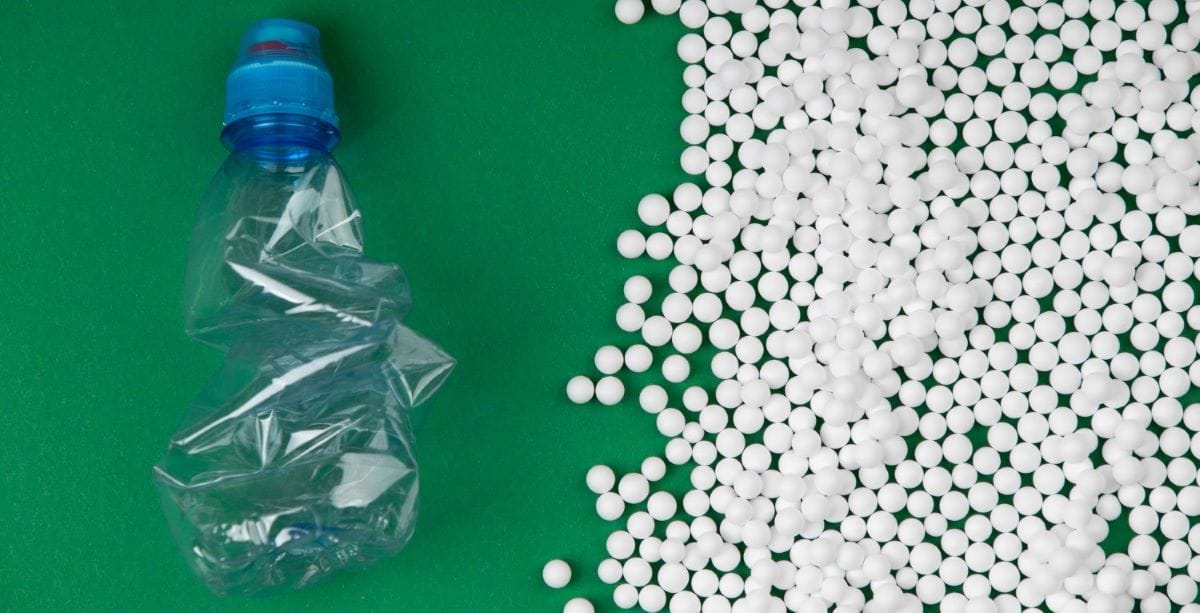
Plastic does not disappear after it is thrown away. Every year, humans produce more than 400 million metric tons of plastic, and much of it stays in the environment, adding up to billions of tons across land, rivers, and oceans. Most of it is not recycled. It remains for a long time and slowly breaks into smaller pieces. Plastic can take around 450 years to break down, and even then it does not fully vanish. It turns into microplastics that spread through soil, water, and living systems. These particles can enter food chains and raise concerns about long-term health effects. Previous research highlights how plastic pollution is increasingly linked to environmental and health concerns, including its long-term impact on ecosystems and human health (see related analysis).
Plastic waste is often treated as something without value, yet this study asks a simple but striking question: can that same waste be turned into something that helps treat disease? At the center of this idea, scientists used engineered Escherichia coli to convert PET plastic into levodopa, also called L-DOPA, a key compound used in the treatment of Parkinson’s disease.
The process starts with PET plastic, which is commonly found in bottles and packaging. When PET breaks down, it forms terephthalic acid. The researchers designed bacteria with added genes so that they could process this chemical step by step. Inside the cell, terephthalic acid is converted into protocatechuate, then into catechol, and finally into L-DOPA. Each step depends on specific enzymes that carry out the chemical reactions.
The work uses living cells in water under mild conditions, which is different from traditional chemical methods. Other approaches have explored how plastic can be transformed using environmental factors such as sunlight, showing that waste plastic can undergo chemical changes under certain conditions. The bacterial system carries out all steps inside the cell, but this also creates limits. The enzymes must function together without interfering with each other, and the compounds must move efficiently through the cell.
How Bacteria Turn Plastic into L-DOPA
One challenge in this system is getting terephthalic acid into the bacterial cell. At neutral pH, the compound does not easily pass through the cell membrane. To address this, the researchers added a transporter protein called TpaK. This protein helps move the molecule into the cell. With better transport, the bacteria can process more of the starting material. Another issue comes from the way chemicals interact inside the cell. The intermediate compound protocatechuate builds up during the process. This compound slows down the enzyme that produces L-DOPA in the final step. When this happens, the overall production drops.
To deal with this, the researchers used two different strains of bacteria instead of one. One strain converts terephthalic acid into catechol. The second strain converts catechol into L-DOPA. This split keeps the intermediate compound from interfering with the final step. The two strains work together, each handling a part of the pathway. The system produced up to 5.0 grams of L-DOPA per liter under controlled conditions. This shows that the pathway can function and produce measurable amounts of the compound. The experiments were done in laboratory settings, where conditions such as temperature, pH, and nutrient supply are controlled.
Solving Challenges in the Process
The system depends on several factors working together. Transport of materials into the cell, enzyme performance, and balance of chemical intermediates all affect the final result. When one part of the pathway slows down, the entire process is affected. Plastic waste also varies. The study used different types of PET materials, including industrial waste and used bottles. These materials are not identical, and their differences affect how well they are broken down and converted. Impurities in plastic can also interfere with the process and affect the final product.
Another factor is the stability of L-DOPA. The compound can break down or react further if conditions are not controlled. This creates an additional step if the compound needs to be stored or purified after production. The system also uses plasmids to carry the engineered genes. These plasmids often require antibiotics to remain stable in the bacteria. This is suitable for laboratory work, but it is not ideal for large-scale production, where different methods are usually preferred.
From Lab Experiment to Real-World Possibility
The results come from controlled experiments. They show that the conversion is possible under specific conditions. The reported yield of 5.0 g/L reflects these controlled settings. It does not represent large-scale production. The system still needs to be adapted for industrial use. Large-scale processes require stable performance over time, consistent output, and cost efficiency. These factors are not yet addressed in full. There is also the issue of scaling. What works in a small flask in a lab may not behave the same way in a large reactor. Changes in mixing, oxygen levels, and nutrient distribution can affect the bacteria and their activity.
Why this Research Matters for the Future
The study fits into ongoing work on using biology to process waste materials. PET plastic is widely used, and large amounts of it end up as waste. At the same time, L-DOPA is an important medicine. The study connects these two areas by using one as the source of the other. This approach treats plastic as a source of carbon. Instead of discarding it, the carbon in plastic can be reused in new chemical products. This idea is part of research into circular systems, where materials are reused rather than discarded after a single use. Similar efforts are being explored where plastic waste is converted into valuable compounds, including advanced chemicals and pharmaceutical precursors. The study also includes an additional step involving carbon dioxide. During the chemical reactions, CO2 is released. The researchers used a type of microalgae to capture this CO2. The algae use it for growth through photosynthesis. This adds another layer to how the system handles carbon, though the full impact of this step is not measured in the study.
A Step Toward a Smarter and Cleaner World
The process described in the study shows that bacteria can be engineered to perform specific chemical conversions. It connects waste processing with chemical production in a single system. At the same time, the system has clear limits. It requires controlled conditions, precise genetic design, and careful handling of materials. The results are tied to laboratory conditions and do not yet represent a full industrial solution. The study shows a working example of converting plastic into a useful chemical. It demonstrates how biological systems can be used to carry out multi-step chemical processes, using waste materials as inputs.
FAQs on Plastic Waste to Parkinson’s Drug
Q: How is plastic waste converted into L-DOPA using bacteria?
A: Plastic waste, specifically PET, is first broken down into smaller compounds like terephthalic acid. Engineered Escherichia coli then use added genes and enzymes to convert these compounds step by step into L-DOPA. The process includes multiple chemical reactions inside the bacterial cells, each controlled by specific enzymes.
Q: What is L-DOPA and why is it important in medicine?
A: L-DOPA is a compound used in the treatment of Parkinson’s disease. It helps the brain produce dopamine, a chemical that is reduced in people with this condition. This makes it an essential medication for managing movement-related symptoms.
Q: Can plastic waste really be used to make medicine?
A: Yes, research shows that plastic waste can be transformed into useful chemicals, including pharmaceutical compounds like L-DOPA. This is done through engineered biological systems that convert plastic-derived molecules into higher-value products. However, this is still at a laboratory stage and not yet used at an industrial scale.
Q: How long does it take for plastic to decompose in the environment?
A: A plastic bottle can take around 450 years to break down. Even after this time, it does not fully disappear but instead breaks into microplastics. These particles persist in the environment and can enter soil, water, and food chains.
Q: What are the environmental and health impacts of plastic waste?
A: Plastic waste accumulates in ecosystems and breaks down into microplastics, which can spread widely in the environment. These particles have been found in water, food, and even inside the human body, raising concerns about long-term health effects. Studies continue to explore how this widespread exposure impacts ecosystems and human health.
Q: How does this method compare to traditional plastic recycling?
A: Traditional recycling focuses on reprocessing plastic into new materials, but it has limitations in efficiency and scope. The biological method converts plastic into entirely different high-value products like L-DOPA. While promising, this method is still experimental compared to established recycling systems.
Q: What are the challenges in converting plastic waste into L-DOPA?
A: There are several challenges, including inefficient transport of raw materials into bacterial cells, enzyme inhibition during the chemical process, and instability of the final product. Additionally, scaling the process for industrial use and maintaining consistent output remain significant hurdles.
Q: Why is a two-strain bacterial system used instead of a single strain?
A: A two-strain system is used to solve the problem of enzyme inhibition caused by intermediate compounds. One strain handles the early steps of converting plastic into intermediate chemicals, while the second strain converts those intermediates into L-DOPA. This separation improves efficiency and prevents interference within the pathway.
Q: Is this method ready for large-scale industrial use?
A: No, this technology is still in the research and proof-of-concept stage. While it has shown successful results in laboratory conditions, it requires further development to improve scalability, stability, and cost-effectiveness before it can be used in industrial production.
Q: What are the current alternatives to managing plastic waste?
A: Current methods include recycling, reducing plastic use, and reusing materials whenever possible. Some research also explores alternative approaches like using sunlight or biological systems to break down plastic into simpler or useful compounds. These methods together help reduce the environmental impact of plastic waste.
External Sources:
- Royer B, Era Y, Valenzuela-Ortega M, Thorpe TW, Trotter CL, Clouston K, Steele JF, Zeballos N, Shrimpton-Phoenix E, Eiamthong B, Uttamapinant C. Microbial upcycling of plastic waste to levodopa. Nature Sustainability. 2026 Mar 16:1-8. Doi: 10.1038/s41893-026-01785-z.
- Valenzuela-Ortega M, Suitor JT, White MF, Hinchcliffe T, Wallace S. Microbial upcycling of waste PET to adipic acid. ACS Central Science. 2023 Nov 1;9(11):2057-63. Doi: 10.1021/acscentsci.3c00414.
- Tang XL, Liu X, Suo H, Wang ZC, Zheng RC, Zheng YG. Process development for efficient biosynthesis of L-DOPA with recombinant Escherichia coli harboring tyrosine phenol lyase from Fusobacterium nucleatum. Bioprocess and biosystems engineering. 2018 Sep;41(9):1347-54. Doi: 10.1007/s00449-018-1962-8.
Disclaimer:
Some aspects of the webpage preparation workflow may be informed or enhanced through the use of artificial intelligence technologies. While every effort is made to ensure accuracy and clarity, readers are encouraged to consult primary sources for verification. External links are provided for convenience, and Honores does not endorse, control, or assume responsibility for their content or for any outcomes resulting from their use. The author declares no conflicts of interest in relation to the external links included. Neither the author nor the website has received any financial support, sponsorship, or external funding. This content is for informational purposes only and is not medical advice. Please consult a qualified physician before making health decisions. Images are for representational purposes only. Image by Roland Steinmann from Pixabay.