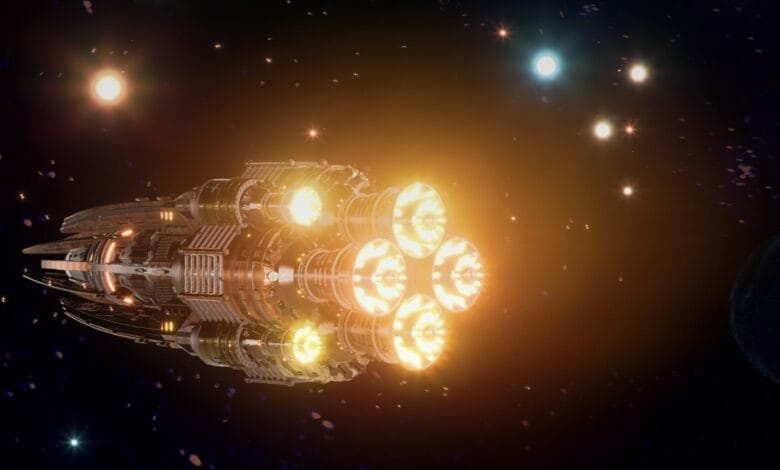
Space travel is entering a revolutionary phase. What once required the resources of superpowers is now being pursued by startups, private companies, and international collaborations. Reusable rockets and planned missions to the Moon and Mars are turning long-held dreams into reality. Yet space reminds us of its vastness. Mars lies about 55 to 400 million kilometers from Earth, and even with today’s spacecraft the journey still takes six to nine months. During this time astronauts would remain in microgravity and face exposure to cosmic radiation. Because of these conditions, researchers continue to study propulsion systems that could shorten travel time.
A group of Russian scientists has developed a prototype engine designed for space travel. The design uses plasma propulsion instead of the chemical rockets commonly used today. Reports suggest that this type of engine could shorten travel time to Mars compared with current spacecraft. Scientists at the Troitsk Institute, part of Russia’s Rosatom nuclear technology sector, built and tested the prototype. Reports about the project state that a spacecraft using this propulsion system could reach Mars in about 30 to 60 days if the technology works as expected in space.
How the Plasma Propulsion Engine Works
The prototype engine uses plasma propulsion instead of chemical combustion. In this system, hydrogen gas is converted into plasma. Plasma is a gas made of charged particles. Electric and magnetic fields accelerate these charged particles inside the engine. As the particles leave the engine at high speed, they create thrust that pushes the spacecraft forward. Engineers involved in the project report that particles in the exhaust stream may reach speeds close to 100 kilometers per second. This speed is higher than the exhaust speed of chemical rockets, which is usually about 4.5 kilometers per second.
Higher exhaust speed improves fuel efficiency. Engineers describe this efficiency using the term specific impulse. When exhaust velocity is high, the engine can continue accelerating a spacecraft while using less propellant. The prototype has been tested inside a 14 meter vacuum chamber designed to simulate space conditions. During tests, the engine operated with about 300 kilowatts of electrical power and produced approximately six newtons of thrust. Electric propulsion systems produce lower thrust than chemical rockets, but they can operate continuously for long periods.
Why Faster Mars Travel Matters
A shorter trip to Mars would reduce the time astronauts spend in interplanetary space. Long missions expose crews to cosmic radiation and extended periods of microgravity. Reducing travel time would also change how missions are planned. Faster transit could allow spacecraft to deliver cargo or scientific equipment to Mars more often. Mission planners could adjust launch timing and supply missions more easily. These possible benefits depend on whether plasma propulsion systems can operate reliably during long space missions.
The Engineering Challenges Ahead
Several technical challenges remain before this type of propulsion system can be used in a real Mars mission. One challenge is electrical power. Plasma propulsion requires a continuous and high level of energy. The prototype already uses hundreds of kilowatts during testing. Solar panels can generate power near Earth, but their output decreases as spacecraft travel farther from the Sun. Because of this limitation, some researchers consider nuclear reactors as a possible power source for deep space propulsion.
Another issue involves thrust. Electric propulsion systems provide lower thrust than chemical rockets. Instead of short powerful bursts, they produce steady acceleration over long periods. A spacecraft using this engine would need to accelerate gradually during the trip. Spacecraft design would also need to address heat control, radiation protection, and long term reliability during the journey. Systems must operate for many weeks without failure.
The estimate of a 30 day trip to Mars comes from projections based on laboratory results and mission models. A spacecraft has not yet demonstrated this type of continuous plasma propulsion during an interplanetary mission. Research on advanced propulsion continues in several countries. NASA and other organizations have studied plasma and electric propulsion systems, including concepts such as pulsed plasma rockets and magnetoplasma engines. Before this technology can support a mission to Mars, engineers must complete further testing, verify performance, and demonstrate operation in space environments.
FAQs on Plasma Engine That Could Reach Mars in 30 Days
Q: What is a plasma propulsion engine and how does it work in space travel?
A: A plasma propulsion engine is a type of electric propulsion system that accelerates charged particles to create thrust. In this design, hydrogen gas is converted into plasma and then pushed out of the engine using electric and magnetic fields. As the particles exit at high speed, they push the spacecraft forward through space.
Q: How could a plasma propulsion engine reduce travel time to Mars?
A: A plasma propulsion engine can continuously accelerate a spacecraft for long periods instead of producing short bursts like chemical rockets. Because the exhaust particles move extremely fast, the spacecraft can keep building speed during the journey. This steady acceleration could reduce the trip to Mars from several months to a much shorter time in theoretical mission models.
Q: Can a spacecraft really reach Mars in about 30 days using plasma propulsion?
A: The estimate of a 30 day trip to Mars comes from projections based on laboratory test data and mission simulations. The engine prototype has not yet been tested during a real interplanetary mission. Engineers still need to verify whether the system can operate continuously in space before such travel times become realistic.
Q: Why do plasma engines use hydrogen as the propellant?
A: Hydrogen is the lightest element and can reach very high speeds when turned into plasma and accelerated by electromagnetic fields. High particle speed increases exhaust velocity, which improves the efficiency of the propulsion system. This makes hydrogen a practical choice for experimental plasma propulsion designs.
Q: Why can’t plasma propulsion engines replace chemical rockets for launching from Earth?
A: Plasma engines produce relatively low thrust compared with chemical rockets. Launching a spacecraft from Earth’s surface requires extremely powerful thrust to overcome gravity. Chemical rockets provide that initial force, while plasma propulsion is better suited for long distance travel once a spacecraft is already in orbit.
Q: What are the biggest challenges in building a plasma propulsion system for Mars missions?
A: One of the main challenges is generating enough electrical power in space. Plasma propulsion systems require large amounts of continuous energy, often hundreds of kilowatts or more. Engineers must also solve problems related to heat control, component durability, and long term operation in the space environment.
Q: Would a plasma propulsion spacecraft need nuclear power in space?
A: Many researchers believe nuclear power may be required for high power plasma engines used in deep space missions. Solar panels work well near Earth but produce less energy as spacecraft move farther from the Sun. A nuclear power source could provide the steady electricity needed for continuous propulsion.
Q: How is plasma propulsion different from traditional chemical rocket propulsion?
A: Chemical rockets burn fuel through combustion to produce powerful bursts of thrust. Plasma propulsion systems do not rely on combustion. Instead, they use electric energy to accelerate charged particles, producing a lower but continuous thrust that can move spacecraft efficiently over long distances.
Q: Are other space agencies developing plasma or electric propulsion for Mars missions?
A: Yes. Several space agencies and research groups are studying advanced electric propulsion technologies. For example, NASA has explored concepts such as pulsed plasma rockets and magnetoplasma engines designed for faster deep space travel. These technologies remain under development and have not yet been used for crewed Mars missions.
External Sources:
- NASA. Pulsed Plasma Rocket: Shielded, Fast Transits for Humans to Mars. Available from: https://www.nasa.gov/general/pulsed-plasma-rocket-shielded-fast-transits-for-humans-to-mars/
- Russian engine to reach Mars in one or two months. Accessed from: https://en.iz.ru/en/1835260/2025-02-07/russian-engine-reach-mars-one-or-two-months and https://en.iz.ru/en/1834706/andrei-korsunov/plasma-heart-russian-engine-will-deliver-mars-one-or-two-months
Disclaimer:
Some aspects of the webpage preparation workflow may be informed or enhanced through the use of artificial intelligence technologies. While every effort is made to ensure accuracy and clarity, readers are encouraged to consult primary sources for verification. External links are provided for convenience, and Honores does not endorse, control, or assume responsibility for their content or for any outcomes resulting from their use. The author declares no conflicts of interest in relation to the external links included. Neither the author nor the website has received any financial support, sponsorship, or external funding. Image by Sebastian Drinceanu from Pixabay.