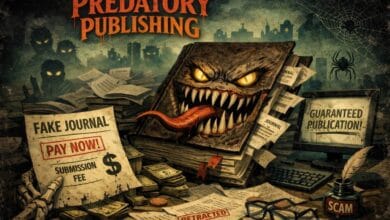
Peer review occupies a near-mythical position in modern science. It is presented as the final quality filter separating rigorous research from speculation, error, or fraud. Governments rely on peer-reviewed studies to shape policy. Clinicians depend on them for treatment decisions. Universities build careers, promotions, and reputations around them.
Yet over the past decade, a growing body of evidence has revealed a disturbing reality: peer review is increasingly vulnerable to manipulation. Investigations by Nature and Retraction Watch have shown that thousands of papers passed peer review not because they met scientific standards, but because the system itself was deceived.
This is not a story of a few bad actors. It is a structural crisis fueled by scale, incentives, and trust-based workflows. As journals race to process unprecedented submission volumes, fraudsters have learned to exploit every weakness which span from fake reviewer identities to organized peer review rings.
When the gatekeepers are bribed, the castle crumbles.
How Peer Review Is Supposed to Work
In principle, peer review is simple. An editor sends a submitted manuscript to independent experts who evaluate its methodology, originality, ethical compliance, and contribution to the field. Based on these reviews, the editor decides whether the paper should be revised, rejected, or published.
This process depends on three core assumptions:
- Reviewers are genuine and appropriately qualified
- Reviews are independent and unbiased
- Editors can identify conflicts or manipulation
According to the Committee on Publication Ethics (COPE), peer review relies heavily on professional trust rather than forensic verification. Historically, this trust functioned because scholarly communities were small and personal reputations were at stake.
Digital publishing changed that equilibrium. Online submission systems, automated reviewer invitations, and author-suggested reviewers introduced efficiency, but also new vulnerabilities.
The Rise of Peer Review Fraud
Peer review fraud refers to deliberate actions intended to manipulate or bypass the review process to secure publication. While isolated cases existed in the past, the phenomenon accelerated sharply after 2010, coinciding with the growth of high-volume digital publishing.
An analysis of retraction data by Retraction Watch shows that peer review manipulation is now among the most common reasons for large-scale retractions, rivaling plagiarism and data fabrication. Unlike honest errors, these cases reveal systematic deception.
The incentives are obvious. Publications drive funding, promotions, visas, and institutional rankings. In hyper-competitive environments, especially where quantitative metrics dominate evaluation, some researchers view peer review not as a safeguard, but as an obstacle to be engineered around.
Peer review didn’t fail by accident; it was exploited by design.


Fake Reviewers and Fabricated Identities
One of the most widespread forms of peer review fraud involves fake reviewer identities. Many journals allow or encourage authors to suggest potential reviewers. Some authors exploit this by submitting names of real or plausible experts paired with email addresses they control or influence. When review invitations are sent, the authors themselves (or third-parties) submit glowing reviews under false identities. Editors, seeing prompt and positive feedback, often approve publication.
In 2015, Springer and BioMed Central retracted more than 120 papers after uncovering fabricated peer review reports across multiple journals. Nature reported that similar schemes affected publishers worldwide, including Elsevier and Wiley. COPE has since documented numerous cases where fake reviewers were indistinguishable from legitimate ones using standard editorial checks.
When authors become their own reviewers, peer review becomes theatre.
Email Manipulation and Reviewer Impersonation
More sophisticated schemes involve email impersonation rather than entirely fictitious reviewers. In these cases, fraudsters create email addresses that closely resemble legitimate institutional accounts—sometimes differing by a single character.
COPE case files describe incidents where editors unknowingly sent manuscripts to impersonators posing as established scientists, who then submitted fraudulent reviews. Because communication occurs almost exclusively via email, verification is rare.
Publishers have acknowledged that editorial systems were never designed to authenticate identities at scale. Reputed publisher’s research integrity reports confirm that email-based trust models were a critical weakness exploited repeatedly.
Peer Review Rings and Citation Cartels
Beyond individual deception lies a more damaging phenomenon: peer review rings. These are organized groups of researchers who agree to review and approve each other’s work, regardless of quality.
In many cases, review rings overlap with citation cartels, where members systematically cite one another to inflate metrics such as impact factor and h-index. Science documented cases in which suspicious citation patterns directly correlated with editorial decisions influenced by compromised peer review.
These practices distort not only journal quality but also research assessment systems. Funding bodies and universities relying on bibliometrics unknowingly reward manipulated outputs.
Paper Mills and the Industrialization of Fraud
In recent years, peer review fraud has evolved into an industrial enterprise. Paper mills, commercial operations selling authorship, manuscripts, and fraudulent peer review as bundled services are now operate globally.
A 2023 Nature investigation revealed that some paper mills maintained entire networks of fake reviewers and reviewer accounts, allowing them to manipulate editorial workflows at scale. Paper mills’ customers paid not only for papers, but for guaranteed acceptance.
Retraction Watch has linked thousands of retractions to paper mill activity, particularly in biomedical journals under intense publication pressure.
Peer review fraud is no longer artisanal—it’s industrial.
High-Profile Journal Scandals and Mass Retractions
Mass retractions exposed the true scale of the problem. Springer Nature, Elsevier, and other major publishers have all issued statements acknowledging systemic peer review manipulation. These retractions often occur years after publication, meaning flawed research may already have influenced subsequent studies, clinical practice, or policy. As Retraction Watch notes, retractions represent detected fraud, not total fraud.
Why Journals Failed to Detect the Fraud
Journals did not ignore the problem, but they were structurally unprepared for it. Editors are often unpaid academics managing hundreds of submissions annually. Verification procedures slow workflows and increase costs. Commercial publishing models reward throughput, not caution.
As The Guardian observed, scientific publishing increasingly resembles “a volume-driven industry operating under the language of quality control”. COPE has repeatedly warned that ethical safeguards have not kept pace with scale.
In a system built on trust, speed became the enemy of scrutiny.”
Consequences for Science, Policy, and Public Trust
Peer review fraud not only undermines journals but also the science itself. During the COVID-19 pandemic, rushed peer review allowed flawed studies to circulate widely before retraction, contributing to confusion and misinformation. Weak evidence influenced public discourse and policy debates. Long-term, repeated scandals erode public trust. When peer review fails, skepticism extends beyond individual papers to scientific authority as a whole.
Can Peer Review Be Fixed?
Most experts agree peer review remains indispensable, but it must evolve. The proposed reforms include:
- Mandatory ORCID-based reviewer verification
- Reduced reliance on author-suggested reviewers
- Open or transparent peer review models
- AI-assisted anomaly detection
- Reforming incentive structures that reward quantity over quality
Almost all publishers (major & minor) have announced new integrity checks, but critics argue these measures remain reactive.
Peer review cannot be fixed without fixing academic incentives.
Frequently Asked Questions (FAQs) for Peer Review Fraud
Q: What is peer review fraud?
A: Deliberate manipulation of the review process through fake reviewers, impersonation, or collusion.
Q: How widespread Peer Review Fraud is?
A: Retraction data suggest thousands of papers globally are affected so far. The Retraction Watch Database has over 63,000 retractions listed.
Q: Are top journals immune to Peer Review Fraud?
A: No. High-impact publishers have issued mass retractions linked to peer review fraud. The retraction data contains articles (related to peer review fraud retractions) from the top journals & reputed publishers.
Q: What are paper mills in Academia?
A: Commercial services selling manuscripts, authorship positions and fraudulent peer review. They have operate in various levels, across all countries and almost in all known channels.
Q: Why didn’t editors catch Peer Review Fraud earlier?
A: Large Scale operations (by various services like paper mills & authors), high volume of articles to process, and limited resources (for the Editors in Trust-based systems provided by publishers) are making it hard for Editors to catch it.
Q: Do retractions solve the Peer Review Fraud problem?
A: They can only mitigate damage but do not address root causes. Generally retractions will published after a clear investigation. During this course of time, the article remains on the web and being read.
Q: Is open peer review safer from Peer Review Fraud?
A: Some studies suggest that open peer-review can improve transparency but introduces new risks. Organizations & Publishers should work on mitigating the risks if open peer review is the way out.
Q: Can technology help in preventing the Peer Review Frauds?
A: Yes, but only alongside incentive reform. But it will raise another couple of questions. Are the Organizations & Publishers ready to work on it? are they ready to invest on this niche?
Q: Should authors suggest reviewers at all?
A: Many experts argue this practice should be restricted. But this comes with the price the publishers don’t really want to pay.
External sources
- Haug CJ. Peer-review fraud—hacking the scientific publication process. New England Journal of Medicine. 2015 Dec 17;373(25):2393-5.
- Ferguson, C., Marcus, A. & Oransky, I. Publishing: The peer-review scam. Nature 515, 480–482 (2014).
- Committee on Publication Ethics (COPE). Ethical guidelines for peer reviewers. London: COPE; 2017.
- Brainard J. Rethinking retractions. Science. 2018;362(6413):390–393.
- Callaway, E. Faked peer reviews prompt 64 retractions. Nature (2015). Doi: 10.1038/nature.2015.18202.
- Retraction Watch. Retraction database: Tracking retractions as a window into the scientific process. Available from: https://retractionwatch.com
- Horbach SPJM, Halffman W. The ability of different peer review procedures to flag problematic publications. Scientometrics. 2019;118(1):339-373. Doi: 10.1007/s11192-018-2969-2.
Disclaimer
This article is for informational purposes only. It does not constitute professional advice and should not replace consultation with institutional advisors or ethics boards. Some content on this page may have been created or reviewed with the help of artificial intelligence tools. While every effort is made to ensure reliability, readers are advised to consult primary sources. External links and references are offered for convenience, and Honores is not liable for their content or impact.