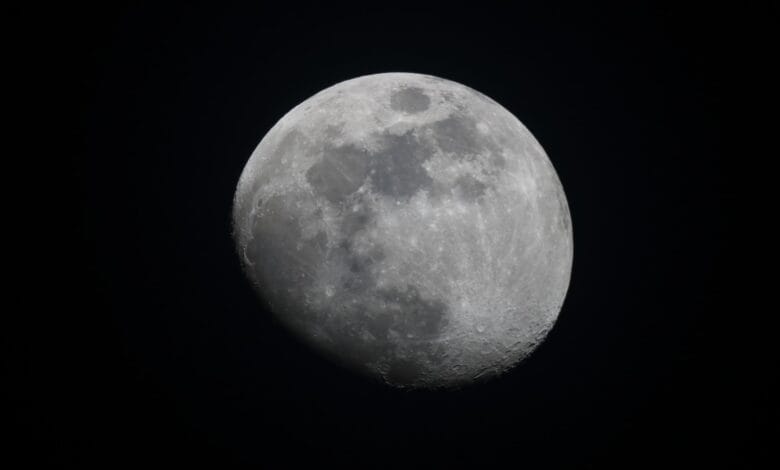
Every night the Moon rises quietly above Earth, glowing with a steady light that has guided travelers, inspired stories, and shaped calendars for centuries. To the naked eye it looks silent, same and still, like a world that stopped changing long ago. Yet the Moon is not as motionless as it appears. Careful observations and modern space missions now show that the Moon is still changing but slowly. This will help scientists better understand how rocky planets and moons develop over long periods of time.
The Moon often appears calm and unchanged when viewed from Earth. Its surface shows many craters and wide plains. For many years, scientists thought most geological activity on the Moon ended long ago. Recent research indicates that the Moon is still slowly shrinking, and this process leaves marks across its surface. A recent study mapped more than 1,100 small ridges across the Moon’s dark plains, known as lunar maria. These ridges show that the surface continues to adjust as the Moon’s interior cools. The findings help researchers examine the Moon’s geological history and the evolution of rocky planetary bodies.
Scientists Discover Small Ridges Across the Lunar Maria
Researchers studied high resolution images captured by spacecraft orbiting the Moon. One major source of these images is the Lunar Reconnaissance Orbiter operated by NASA. These observations allow scientists to examine fine surface features that were not visible in earlier lunar missions. During this analysis, researchers identified many small ridges distributed across the lunar maria. These structures are called small mare ridges. They are shallow faults formed when the Moon’s crust compresses.
The research team combined orbital images with topographic measurements that describe the shape and height of the surface. By examining ridge shape, orientation, and location, scientists classified these structures and estimated their relative ages. Results indicate that many ridges formed less than 310 million years ago. In geological terms this is considered young. This evidence shows that parts of the Moon’s surface have remained tectonically active.
Why the Moon Is Slowly Shrinking
The Moon is shrinking because its interior continues to cool. Earlier in its history the Moon contained more internal heat. Over time this heat gradually escaped into space. As the interior cools, the outer crust compresses. This compression can fracture and shift sections of the crust. The movement forms shallow thrust faults that push sections of the surface upward and create ridges.
Researchers estimate that this cooling has reduced the Moon’s diameter by several tens of meters over hundreds of millions of years. Although the change is small, it is sufficient to produce visible structures on the surface. Compression of the crust can also produce moonquakes. During the Apollo missions, instruments placed on the Moon recorded minor seismic activity associated with contraction faults.
Differences Between the Maria and the Highlands
The Moon’s surface contains two main types of terrain. The lighter areas are called the highlands, and the darker plains are called the maria. Each region shows evidence of contraction, but the features differ. In the highlands, scientists have identified larger structures known as lobate scarps. These formed when the crust folded during earlier stages of cooling.
Small mare ridges found in the maria are different. They are younger and appear in areas where volcanic lava once spread across the surface and cooled into basalt plains. Because the maria formed later in the Moon’s geological history, the ridges there reflect more recent adjustments of the crust. Crust thickness, cooling history, and volcanic activity in the maria influence how contraction appears in these regions.
What This Discovery Means for Future Lunar Exploration
Mapping contraction features helps scientists study how the Moon has cooled over long periods. The location of these faults also has practical importance for future lunar missions. Programs such as NASA’s Artemis mission plan to return astronauts to the Moon and establish long term operations. Information about contraction faults and possible moonquake activity may assist in evaluating landing sites and engineering requirements for surface structures.
Researchers also compare these processes with other planetary bodies. Mercury shows similar contraction features caused by internal cooling. On Earth, plate tectonics dominates crustal movement and masks smaller contraction features. Global mapping of small mare ridges shows that the Moon continues to experience slow contraction. Cooling of the interior still affects the lunar crust and produces small faults across both the maria and the highlands. Future missions may provide additional measurements of seismic activity and surface deformation on the Moon.
FAQs on Moon is Still Shrinking
Q: Is the Moon really shrinking over time?
A: Yes. Scientists have found evidence that the Moon is slowly shrinking as its interior cools. As heat escapes from the Moon’s interior, the crust compresses slightly, forming small ridges and shallow faults on the surface.
Q: What are small mare ridges on the Moon?
A: Small mare ridges are low, narrow ridges found across the Moon’s dark plains called lunar maria. These ridges form when the lunar crust is pushed together during contraction. Scientists mapped more than 1,100 of these ridges using orbital imagery.
Q: Why the Moon is shrinking?
A: The Moon is shrinking because it is gradually losing heat from its interior. As the mantle cools, the outer crust compresses and forms shallow thrust faults. This process slowly changes the shape of the lunar surface.
Q: How did the scientists discover that the Moon is still shrinking?
A: Researchers analyzed high resolution images and topographic data from lunar orbiters such as NASA’s Lunar Reconnaissance Orbiter. By mapping ridges and studying their shape and distribution, scientists identified signs of recent tectonic activity.
Q: What is the difference between lunar maria ridges and highland scarps?
A: Lunar highlands contain larger structures called lobate scarps that formed earlier in the Moon’s history. Small mare ridges in the maria are younger and appear in basalt plains created by ancient volcanic activity. Both features are related to the Moon’s contraction.
Q: Can the shrinking Moon cause moonquakes?
A: Yes. When the lunar crust compresses and forms faults, it can release energy as small moonquakes. Instruments placed on the Moon during the Apollo missions detected seismic activity linked to these contraction features.
Q: Does the Moon shrinking affect Earth in any way?
A: No direct effects on Earth have been observed. The shrinking process happens slowly and is limited to the Moon’s internal geological changes. Its main importance is for scientific research about planetary evolution.
Q: How much has the Moon shrunk over time?
A: Scientific estimates suggest the Moon’s diameter has decreased by several tens of meters over hundreds of millions of years. Although this change is small, it is enough to create visible ridges and faults on the surface.
Q: Why studying the shrinking Moon is important for future lunar missions?
A: Understanding where contraction faults and ridges exist helps scientists identify areas where moonquakes might occur. This information may help engineers choose safer landing sites and design stable structures for future lunar exploration missions.
External Sources
- Nypaver CA, Watters TR, Banks ME, Clark JD, Frueh T. A New Global Perspective on Recent Tectonism in the Lunar Maria. The Planetary Science Journal. 2025 Dec 1;6(12):302. Doi: 10.3847/PSJ/ae226a.
- National Aeronautics and Space Administration (NASA). Shrinking Moon May Be Generating Moonquakes. Available from: https://www.nasa.gov/news-release/shrinking-moon-may-be-generating-moonquakes/
Disclaimer:
Some aspects of the webpage preparation workflow may be informed or enhanced through the use of artificial intelligence technologies. While every effort is made to ensure accuracy and clarity, readers are encouraged to consult primary sources for verification. External links are provided for convenience, and Honores does not endorse, control, or assume responsibility for their content or for any outcomes resulting from their use. The author declares no conflicts of interest in relation to the external links included. Neither the author nor the website has received any financial support, sponsorship, or external funding. Image by wirestock on Freepik.