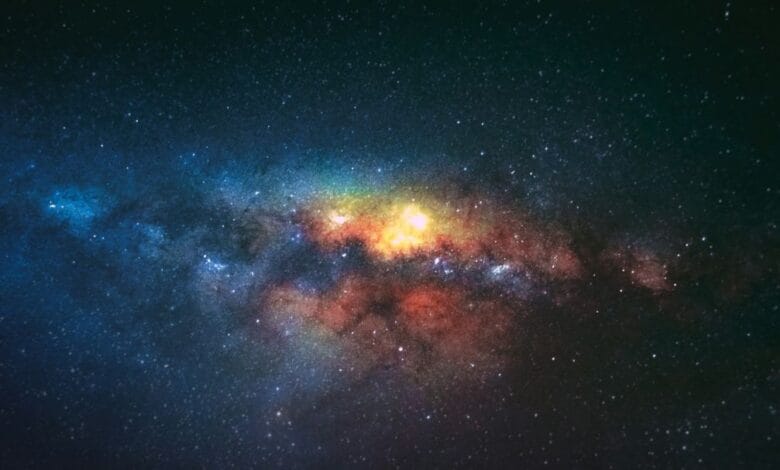
The search for the earliest stars radio signals is entering a transformative phase. Astronomers now aim to capture the faint 21-centimeter hydrogen-line emissions from the Universe’s first luminous objects, offering a direct glimpse into the Cosmic Dawn. These signals, traveling over 13 billion years, could finally reveal how the first stars and galaxies shaped the intergalactic medium, mapped the earliest fluctuations in matter, and influenced the Universe’s large-scale structure.
Mapping the Universe’s First Light
The first stars formed roughly 100–400 million years after the Big Bang, during a period often called the Cosmic Dawn. Unlike the bright stars and galaxies we observe today, these primordial stars were embedded in a fog of neutral hydrogen. Their radiation ionized and heated surrounding hydrogen, imprinting subtle features in the radio spectrum. Detecting these ancient signals requires unprecedented sensitivity, as the 21-cm signal is extraordinarily faint and buried beneath foreground noise from galaxies, the Milky Way, and terrestrial interference.
Capturing the Universe’s first radio whispers could transform our understanding of when and how the very first stars lit up the cosmos.
The 21-Centimeter Hydrogen Line: A Cosmic Messenger
Hydrogen, the Universe’s most abundant element, emits radiation at a wavelength of 21 centimeters due to the hyperfine transition in its ground state. In the early Universe, this signal offers a unique probe of neutral hydrogen before and during the emergence of the first stars. By mapping the absorption and emission features of the 21-cm line across space and time, astronomers can reconstruct the timing of star formation, the intensity of ultraviolet radiation, and the thermal history of the intergalactic medium.
Understanding the Signal Challenges
The 21-cm line’s faintness is compounded by galactic and extragalactic foreground emissions that are orders of magnitude stronger. Advanced data-processing techniques, calibration strategies, and array designs are essential to separate the primordial signal from these contaminants. Arrays like the Square Kilometre Array (SKA), along with its precursor instruments, are tailored to meet these challenges, enabling direct observation of the Universe’s earliest stars.
New Radio Telescope Arrays: SKA and Precursors
The Square Kilometre Array (SKA) represents the next generation of radio astronomy, designed to deliver unparalleled sensitivity and resolution. SKA’s global collaboration involves thousands of antennas spread across continents, allowing astronomers to probe faint signals across vast swathes of the sky. Precursor instruments, such as the Hydrogen Epoch of Reionization Array (HERA) and the Low-Frequency Array (LOFAR), have already begun testing techniques and refining models for the detection of the 21-cm signal.
The combination of SKA and precursor arrays may finally let us watch the Cosmic Dawn unfold, not in visible light, but through the ancient radio waves of hydrogen.
Technical Innovations
Key innovations include precise calibration of instrumental responses, robust RFI (radio-frequency interference) mitigation, and advanced algorithms for foreground subtraction. Together, these developments make it possible to detect signals previously drowned out by stronger emissions, bringing the Universe’s first stars into observational reach.
Modeling the First Stars and Their Environments
Simulations of the early Universe predict that the first stars were massive, short-lived, and formed in small dark matter halos. Their ultraviolet radiation ionized hydrogen, creating expanding bubbles that imprint characteristic fluctuations in the 21-cm signal. By analyzing the amplitude and spatial distribution of these fluctuations, astronomers can infer the masses, luminosities, and clustering of the earliest stellar populations.
The 21-cm signal not only traces ionization but also encodes information about the thermal history of hydrogen gas. Observations can reveal when hydrogen was heated by X-rays from early galaxies, how efficiently the first stars emitted ultraviolet photons, and when cosmic reionization accelerated. These insights are crucial for constraining models of galaxy formation and the evolution of the intergalactic medium.
Anticipated Discoveries and Scientific Impact
Detecting the earliest stars radio signals promises to revolutionize our understanding of the first billion years of cosmic history. Scientists anticipate mapping fluctuations on scales ranging from a few to hundreds of megaparsecs, providing direct constraints on:
- Timing of the first star formation episodes
- Intensity and spectrum of early ultraviolet radiation
- Growth of ionized hydrogen bubbles during reionization
- Nature and distribution of dark matter in the early Universe
Observing these primordial radio signals could finally answer how the cosmos transitioned from a uniform hydrogen fog into a richly structured Universe.
While radio signals probe neutral hydrogen directly, other observations across infrared and optical wavelengths provide complementary information. Space telescopes like JWST (James Webb Space Telescope) are detecting early galaxies in infrared light, offering a cross-check for the timing and properties inferred from 21-cm data. Combining these datasets will allow a more complete reconstruction of the first stars and galaxies, validating models and constraining theoretical uncertainties.
Challenges and Limitations
Despite technological advancements, detecting the 21-cm signal remains daunting:
- Foreground emissions are orders of magnitude brighter than the target signal.
- Instrumental calibration must reach unprecedented precision.
- Cosmic variance in early star formation adds uncertainty.
- Modeling assumptions, such as initial mass functions and radiation efficiencies, affect signal interpretation.
Even so, cautious optimism prevails, as precursor instruments have successfully demonstrated key techniques that SKA will scale up.
Implications for Cosmology and Dark Matter
By probing the early intergalactic medium, astronomers can test models of dark matter. The timing and scale of the 21-cm fluctuations are sensitive to the distribution and behavior of dark matter, offering potential insights into its properties beyond gravitational effects. Furthermore, mapping Cosmic Dawn provides a baseline for understanding the evolution of large-scale structure, bridging the gap between the Cosmic Microwave Background and the emergence of the first galaxies.
Looking Ahead: The Promise of Cosmic Cartography
The next decade promises an era of cosmic cartography, where radio telescopes trace the earliest structures of the Universe. SKA, combined with complementary instruments, will transform theoretical predictions into observable maps, revealing:
- Spatial distribution of first stars
- Evolution of hydrogen reionization
- Thermal history of the early Universe
- Connections between early galaxies and large-scale cosmic structures
This radio window will allow astronomers to reconstruct the Universe’s infancy with unprecedented clarity, providing a bridge between simulations and observations.
For the first time, humanity is poised to listen to the faintest whispers from the Universe’s earliest stars, unlocking secrets of Cosmic Dawn that have remained hidden for over 13 billion years.
Conclusion
Detecting the earliest stars radio signals is no longer a distant aspiration. With SKA and its precursors, astronomers are on the cusp of unveiling the first light of the cosmos, mapping how neutral hydrogen transformed under the influence of the first stars. These observations will illuminate the timing of reionization, the properties of early stellar populations, and potentially even the nature of dark matter. While challenges remain, the coming years promise a revolution in our understanding of Cosmic Dawn — a transformation from theory to direct observation, revealing the origins of cosmic structure and the dawn of the first stars.
Disclaimer
Some aspects of the webpage preparation workflow may be informed or enhanced through the use of artificial intelligence technologies. While every effort is made to ensure accuracy and clarity, readers are encouraged to consult primary sources for verification. External links are provided for convenience, and Honores is not responsible for their content or any consequences arising from their use.
Sources
- SKA Organization. “The Square Kilometre Array: Exploring the Universe with Radio Waves.”
- HERA Collaboration. “Hydrogen Epoch of Reionization Array Overview.”
- LoFAR. “The Low-Frequency Array for Radio Astronomy.”