Key Takeaways
- Polyethylene microplastic exposure increased liver injury markers in experimentally exposed mice.
- Spatial transcriptomics mapped inflammatory gene-expression patterns across distinct liver cell populations.
- Polyethylene exposure correlated with reduced cellular diversity in mice with diet-induced MASH.
- Experimental evidence showed PPARα regulates ANXA2 expression in primary mouse liver cells.
Microplastics are drawing growing attention for their potential effects on human health, but one question remains difficult to answer: what happens when these tiny particles interact with living tissue? Detecting microplastics in the body does not automatically mean they cause harm. The greater challenge is tracing how tissues respond, which biological processes change, and whether those changes lead to injury. Understanding these connections is essential to moving beyond particle detection towards evidence of biological effects.
To investigate this gap, a 2026 study published in Science Advances examined how polyethylene microplastics affect the livers of mice, including animals with diet-induced liver disease. Rather than simply measuring signs of damage, the researchers combined liver-injury assessments, gene-expression analysis and spatial transcriptomics to investigate where changes occurred and which molecular pathways were involved. They found evidence of liver injury and inflammation, alongside a possible regulatory connection between PPARα and ANXA2. The findings provide a more detailed picture of the liver’s response to polyethylene exposure, while leaving open whether comparable effects occur in humans.
This question fits into a wider debate about plastic exposure: as discussed in The Honores’ overview of the health impact of rising plastic use, researchers are investigating potential health effects across multiple exposure routes, while important uncertainties about cause and effect remain.
Polyethylene Microplastics exposure was associated with liver injury
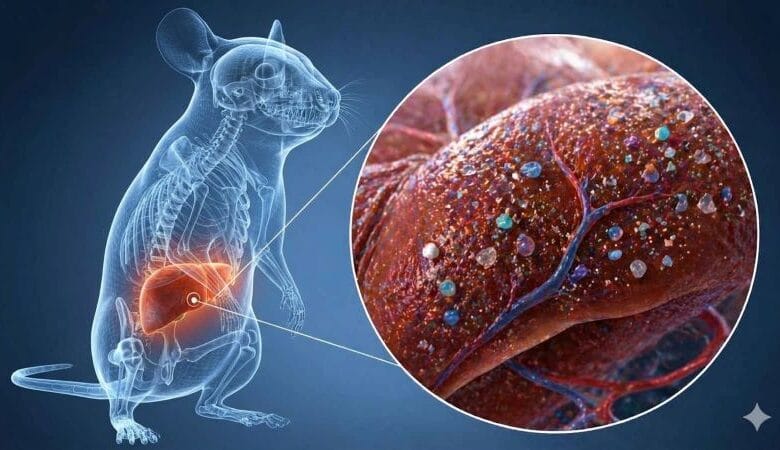
Researchers gave male mice polyethylene particles measuring 10–150 micrometres by daily oral gavage at 2 mg per day for eight weeks. Some animals also received a diet designed to induce metabolic dysfunction-associated steatohepatitis (MASH), a condition involving liver fat accumulation, inflammation and tissue injury.
The polyethylene-treated mice showed increased blood levels of alanine aminotransferase (ALT), a marker of liver-cell injury. In animals receiving the MASH-inducing diet, polyethylene exposure was also associated with higher liver triglyceride levels and increased fat accumulation. The findings suggest that polyethylene exposure aggravated several aspects of liver stress under the experimental conditions, rather than demonstrating uniform worsening across all measures.
Mapping inflammation inside the liver
To investigate the biological response, researchers first used bulk RNA sequencing to identify changes in gene activity across liver tissue. The analysis revealed alterations in genes associated with lipid metabolism and responses to potentially harmful substances. Bulk sequencing, however, averages signals across different cell populations. It cannot reliably show where a molecular response originates within a complex tissue.
The researchers addressed this limitation using spatial transcriptomics, which measures gene activity while retaining information about the cells’ locations. Their analysis identified 15 liver cell types or subtypes and mapped inflammatory gene-expression patterns across different regions of the liver.
In the MASH-diet group exposed to polyethylene, inflammatory gene-signature strength was inversely correlated with cellular diversity (R = −0.52), meaning that stronger inflammatory signatures tended to occur alongside lower diversity. This association does not establish that inflammation caused the change in cell populations. The researchers also observed changes in the relative proportions of several immune and other nonparenchymal cell populations.
These findings help locate the tissue changes associated with exposure, but altered cell proportions do not independently establish whether cells died, migrated or changed their identity. The team also detected polyethylene signatures in liver tissue using complementary spectroscopic techniques. Some particle signals appeared near regions enriched in Kupffer cells, immune cells involved in clearing material from the liver. This spatial proximity does not, by itself, prove that these cells directly took up the particles or caused the observed inflammation.
A possible PPARα–ANXA2 mechanism
The spatial analysis highlighted Anxa2, the gene encoding annexin A2 (ANXA2), a protein involved in processes including cell movement and tissue remodelling. Its expression increased in particular hepatocyte regions in mice receiving both polyethylene and the MASH-inducing diet. Further analyses implicated peroxisome proliferator-activated receptor alpha (PPARα), a regulator of lipid metabolism and other liver functions.
The researchers supported this proposed connection using PPARα binding analyses and experiments in primary mouse liver cells. Activating PPARα increased Anxa2 expression, while pharmacological inhibition or genetic reduction of PPARα suppressed the response. Additional evidence from mice lacking Ppara supported a regulatory relationship. These experiments strengthen the case that PPARα regulates ANXA2 under the conditions tested. They do not establish that this pathway accounts for all the liver injury associated with polyethylene exposure.
Does ANXA2 help or harm the liver?
The biological significance of increased ANXA2 remains unresolved. The protein has been associated with tissue-repair processes, but it has also been implicated in mechanisms relevant to fibrosis and metabolic liver disease. Consequently, increased Anxa2 expression could represent a response to tissue damage without necessarily indicating successful recovery. The study did not establish whether manipulating ANXA2 improves or worsens liver injury, inflammation or fibrosis. This distinction matters because identifying a molecular pathway is an early step towards understanding disease, not proof that the pathway is a useful therapeutic target.
What the findings mean for human health
Microplastic pollution is not confined to densely populated areas: research on microplastics in Arctic lakes provides a broader environmental context for understanding how plastic particles can reach remote ecosystems, although environmental detection does not establish the effects of exposure on the liver. Plastic pollution can also originate from everyday waste: our report on discarded cigarette butts as a source of microplastic pollution describes how plastic-containing filters can fragment into smaller particles rather than disappear completely.
Human exposure varies in particle size, concentration, composition and route, and the experiment does not establish how its exposure regimen compares with everyday environmental exposure. People may encounter microplastics through different routes, including drinking water; our earlier report on microplastics in bottled water discusses how particle detection varies with measurement methods and why finding particles does not, by itself, establish a health risk.


The spatial transcriptomics analysis also examined a targeted selection of genes rather than the entire transcriptome. In addition, computational separation of neighbouring cells can introduce uncertainty into the assignment of molecular signals. Future studies should test whether the PPARα–ANXA2 pathway directly influences liver injury and recovery, examine different exposure levels and include both sexes. Research using human-relevant models will also be needed to establish whether the findings apply beyond mice.
The study’s principal contribution is a more detailed picture of how polyethylene exposure affects liver tissue under experimental conditions. By combining spatial mapping with functional experiments, the researchers identified a plausible regulatory mechanism that warrants further investigation. Polyethylene exposure was associated with liver injury and altered inflammatory and metabolic responses in mice. Whether comparable effects occur under real-world human exposure remains an open research question.
FAQs on Microplastics and Liver Damage
Q: Can polyethylene microplastics cause liver damage?
A: A mouse study found that oral exposure to polyethylene (PE) microplastics caused liver injury and worsened diet-induced steatohepatitis. More research is needed to determine whether similar effects occur in humans under real-world exposure conditions.
Q: How do microplastics affect liver health?
A: Microplastics may disrupt liver function by triggering inflammation and altering cellular processes. In the mouse study, researchers identified inflammatory hotspots and changes in liver cell diversity following polyethylene microplastic exposure.
Q: What is spatial transcriptomics, and how does it help study microplastic toxicity?
A: Spatial transcriptomics maps gene activity within specific locations in a tissue. It helped researchers identify areas of inflammation and distinct cellular responses in the livers of mice exposed to polyethylene microplastics.
Q: What is the PPARα–ANXA2 pathway in microplastic-induced liver injury?
A: The PPARα–ANXA2 pathway describes a regulatory relationship identified in the study, in which PPARα influenced the expression of ANXA2. Experimental findings suggested that this molecular interaction contributes to the liver’s response to polyethylene microplastic exposure.
Q: Can microplastics worsen MASH or fatty liver disease?
A: In the mouse study, polyethylene microplastic exposure worsened diet-induced metabolic dysfunction-associated steatohepatitis (MASH). Whether microplastics worsen MASH or other fatty liver conditions in humans remains uncertain.
Q: How much polyethylene microplastic exposure is harmful to the liver?
A: The study examined exposure under controlled experimental conditions in mice. It does not establish a safe or harmful exposure threshold for humans, and the health effects of different exposure levels require further investigation.
Q: Are microplastics in food and drinking water a risk to the liver?
A: Food and drinking water are potential routes of human microplastic exposure. However, detecting microplastics in these sources does not by itself establish that typical dietary exposure causes liver damage in humans.
Q: Does this research prove that microplastics cause liver disease in humans?
A: No. The findings provide experimental evidence of liver injury in mice and identify possible molecular mechanisms, but human studies are needed to establish whether comparable exposure causes liver disease in people.
Q: How can scientists determine whether microplastics contribute to liver disease?
A: Researchers can combine controlled exposure studies, spatial transcriptomics, molecular experiments, and human observational research. These approaches can help establish biological mechanisms, assess exposure levels, and determine whether findings in animals apply to human health.
References
- Jung W, Abushukair H, Patil NY, Ampadu F, Firouzi M, Rus I, Choi J, Muthukrishnan SD, Shukla S, Tarantini S, Csiszar A. Spatial transcriptome mapping identifies Ppara-Anxa2 cross-talk in microplastic-induced hepatotoxicity. Science Advances. 2026 Jun 17;12(25):eaec8681. Doi: 10.1126/sciadv.aec868.
- Abdel Ghany F, Yousef MI, El‐Tabakh MA, Kamel MA, El Wakil A. Polystyrene Microplastics Trigger Liver Damage Through Impaired Mitochondrial Biogenesis and Mitochondrial Dynamics. Journal of Biomedical Materials Research Part B: Applied Biomaterials. 2026 Aug;114(8):e70143. Doi: 10.1002/jbm.b.70143.
- Tan X, Zhang M, Lu J, Shi S, Shi X, Hou Z. Hepatotoxic Mechanisms of Polyethylene Terephthalate Microplastics Revealed by Network Toxicology, Molecular Docking, and In Vivo Validation. International Journal of Molecular Sciences. 2026 Apr 3;27(7):3256. Doi: 10.3390/ijms27073256.
Disclaimer:
Some aspects of the preparation of this content may be assisted by artificial intelligence or automated technologies and are subject to human editorial review and source verification. Readers are encouraged to consult the original research and primary sources for complete context. External links are provided for convenience, and TheHonores does not control or endorse their content. Relevant conflicts of interest, funding, sponsorship, or other disclosures are identified where applicable. This content is for informational purposes only and is not professional or medical advice. Images are for illustrative or representational purposes unless otherwise stated.