Key Takeaways
- NASA Moon Base advances humanity’s first outpost on the lunar surface
- Robotic missions and technology demonstrations form the plan’s foundation.
- Lunar South Pole missions could enable sustained human exploration.
- NASA aims to transform brief lunar visits into sustained stays.
For billions of years, Earth’s closest companion has circled above us, showing us essentially the same face while keeping its far side hidden from direct view. Only 12 people have ever walked across its surface, and during the Cold War, the US even studied the possibility of detonating a nuclear device on the Moon. Yet the Moon’s exploration chapters may have little to do with spectacular one-time missions. The bigger question is whether humans can turn this barren world from a place we visit into a place where we can actually stay.
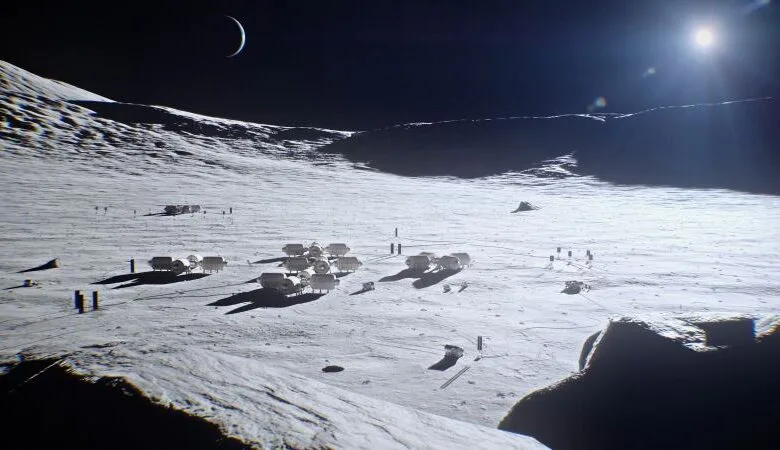
That shift is now becoming a defined NASA objective. In 2026, NASA formally laid out a phased Moon Base strategy aimed at building the capabilities for an enduring human presence near the lunar South Pole. The agency is not putting up one giant building; it is developing the landers, rovers, power systems, communications, logistics and resource technologies that must work together before astronauts can live and work there for extended periods. The journey begins with robotic missions and technology demonstrations, moves into infrastructure deployment, and ultimately aims at a permanent lunar outpost.
That effort became a formal NASA Moon Base program in March 2026, with a phased plan extending from robotic exploration and technology demonstrations to infrastructure deployment and, sustained human operations. The NASA’s current plan places the first phase through 2029, infrastructure development from 2029 to 2032, and permanent-outpost development from 2032 onward.
What Is the NASA Moon Base?
The NASA Moon Base is not a single giant building. NASA describes it as a flexible, expandable outpost that will grow through multiple missions and interconnected systems. Those systems are expected to include habitats, power generation, communications, transportation, logistics, scientific instruments, cargo landers and surface mobility. Some will be delivered by commercial partners, while others will be developed through NASA programs and international collaboration.
Artemis is NASA’s broader human lunar exploration campaign. The NASA Moon Base is the surface infrastructure effort intended to support an enduring presence. Meanwhile, Gateway is a planned small space station in lunar orbit designed to support lunar missions, science and future exploration. NASA’s current Gateway page still describes it as an active program with launch targeted no earlier than 2027.
However, NASA Moon Base strategy has changed how some Gateway hardware and capabilities fit into the overall architecture. NASA says the Gateway team will pivot to support Moon Base development and other high-priority initiatives, with some hardware potentially repurposed for surface-focused objectives.
Why Is NASA Targeting the Lunar South Pole?
The South Pole is attractive because several unusual lunar conditions converge there. The Sun remains low above the horizon, and local terrain creates areas that receive extended periods of sunlight. Such locations could provide more favorable conditions for solar power generation. At the same time, permanently shadowed regions can remain extremely cold and may preserve water ice and other frozen materials.
The combination is potentially valuable: a future lunar base could seek locations with access to sunlight for power while remaining within reach of scientifically and operationally important shadowed regions.
But the same environment makes the South Pole difficult to operate in. Long shadows, rugged terrain, extreme temperature differences and limited direct sunlight in some areas complicate landing, navigation, mobility and equipment operation. Future surface planning also has to account for the Moon’s active geological environment, including contraction-related faults and the possibility of moonquakes; our earlier coverage explains how researchers mapped more than 1,100 young lunar ridges. NASA is therefore using early missions to learn where future infrastructure can be placed and how it can function in this environment.
This visualization flies toward and around the Moon’s South Pole as the surface transitions from natural color to coded elevation colors that highlight the region’s terrain and topography. Thirty features near the lunar South Pole are identified throughout the animation. Data gathered by NASA’s Lunar Reconnaissance Orbiter informed the visualization. ©NASA’s Scientific Visualization Studio
Could Lunar Water Ice Support the Base?
Water ice is one of the reasons the lunar South Pole has attracted so much attention. NASA says permanently shadowed regions near the poles can preserve water ice and other frozen materials, and NASA missions have found evidence of these deposits. However, their distribution is complex, and not every permanently shadowed region contains the same materials or concentrations.
If accessible water ice can eventually be extracted and processed, it could potentially provide water for human operations and feed systems that produce oxygen and hydrogen. That could reduce the amount of material future missions need to transport from Earth. NASA is therefore treating lunar resources as a technology-development problem rather than assuming that water detected from orbit is automatically a usable supply.
What About Oxygen From Lunar Soil?
Another possibility lies in something astronauts would find almost everywhere on the Moon: lunar regolith. Oxygen is chemically bound in minerals within lunar soil. NASA is investigating whether it can be extracted and converted into a usable resource. We have previously discussed the technologies researchers are developing for turning lunar dust into oxygen and what that could mean for future lunar missions.
In February 2026, NASA reported an integrated ground test of its Carbothermal Reduction Demonstration, or CaRD, which used concentrated solar energy to extract oxygen from simulated lunar regolith. The demonstration confirmed production of carbon monoxide as part of the process. NASA’s September 2026 technology solicitation also identified oxygen extraction as one of the capability gaps that need to be advanced for Moon Base development.
The potential significance is substantial. If such technologies eventually work reliably on the Moon, locally sourced oxygen could become part of a broader system for life support or propellant production. For now, however, the technology remains part of the development pathway toward that capability.
NASA is Building the Infrastructure Around the Base
NASA Moon Base’s current strategy begins with robotic missions rather than immediate construction of a finished settlement. The agency’s first phase, running through 2029, is intended to establish reliable lunar access, explore the South Pole, test technologies and gather information needed for later infrastructure. NASA’s plan includes a growing sequence of landers, rovers, communications systems and other surface assets. NASA has selected missions involving companies including Blue Origin, Astrobotic, Firefly Aerospace and Intuitive Machines to deliver science and technology payloads to the lunar surface.
Communications are also being developed specifically for lunar operations. On September 30, NASA awarded Modulate Space Corporation a roughly $38 million contract to develop a scalable lunar communications system incorporating 5G technology and Wi-Fi 6. A lunar-surface flight demonstration is planned for 2028. This is not simply terrestrial cellular infrastructure transported to the Moon. NASA is developing the hardware, software and system architecture for communications in the lunar environment and to support future Moon Base operations.
When Could the NASA Moon Base Be Ready?
NASA Moon Base’s current roadmap divides development into three phases.
- Phase One, now through 2029: robotic missions, environmental studies, technology demonstrations and reliable access to the lunar surface.
- Phase Two, 2029–2032: deployment of early power, cargo transportation, logistics and communications infrastructure to support increasingly complex operations.
- Phase Three, 2032 onward: assembly of a permanent lunar outpost where astronauts can live and work for extended periods.
The agency’s human missions are intended to build toward that infrastructure, as NASA’s Artemis campaign moves toward renewed human activity around the Moon. Under the current Artemis schedule, Artemis III is targeted for 2027 as a crewed demonstration mission in Earth orbit, while Artemis IV is targeted for early 2028 as the first crewed lunar landing of the revised sequence. NASA expects Artemis V, targeted for late 2028, to be the mission when construction of the Moon Base begins to take shape more directly. The broader timeline for humans returning to the Moon is covered in our earlier explainer.
What Happens Next?
The immediate objective is not to finish NASA Moon Base. It is to make lunar operations increasingly reliable. NASA plans to use robotic missions to study the South Pole, test mobility and landing technologies, investigate resources, develop communications and power systems, and establish the logistics needed for larger operations. By the early 2030s, the agency’s plan calls for these separate capabilities to begin functioning as an integrated surface infrastructure.
The NASA Moon Base is emerging less like a single structure and more like an ecosystem of infrastructure. Landers deliver equipment. Rovers move it. Communications connect it. Power systems keep it operating. Resource technologies could eventually reduce dependence on Earth. Habitats provide places for astronauts to live and work.
The deeper significance is therefore not simply that NASA wants humans back on the Moon. It is that NASA is attempting to turn lunar exploration from a series of individual visits into a sustained operating capability. If that infrastructure can be established and maintained, the Moon could become the first place beyond Earth where humans learn, in practical terms, how to build and operate a lasting presence on another world.
That ecosystem could eventually extend beyond power, transportation and communications to include life-support and food-production systems; researchers are already exploring whether potatoes can grow in lunar soil simulants.
FAQs on NASA Moon base
Q: What is NASA Moon Base and what will it be used for?
A: NASA’s Moon Base is a planned, expandable lunar outpost rather than a single large building. It is intended to support scientific research, technology development, logistics and eventually longer-duration human operations on the lunar surface.
Q: When will NASA build a Moon Base?
A: NASA Moon Base current roadmap divides development into phases, with infrastructure deployment planned from 2029 to 2032 and permanent-outpost development beginning from 2032 onward. These are NASA’s planned milestones rather than guaranteed completion dates.
Q: Where will NASA build its Moon Base?
A: NASA is focusing on the lunar South Pole because some areas receive extended sunlight while nearby permanently shadowed regions may contain water ice. The combination could provide important opportunities for power generation and future resource utilization.
Q: How is the NASA Moon Base different from Artemis and Gateway?
A: Artemis is NASA’s broader human lunar exploration campaign, while the NASA Moon Base focuses on developing sustained surface infrastructure. Gateway is a planned lunar-orbit station intended to support lunar missions, science and future exploration, although NASA’s 2026 Moon Base strategy has changed how some Gateway capabilities fit into the overall architecture.
Q: Could NASA use water ice from the Moon for a lunar base?
A: Potentially. Water ice in permanently shadowed lunar regions could eventually provide water for human operations and potentially feed systems that produce oxygen and hydrogen, although extracting and processing these resources requires further technology development.
Q: Can oxygen be made from lunar soil for a Moon Base?
A: Yes, researchers are developing technologies to extract oxygen chemically bound in lunar regolith. NASA has tested solar-powered approaches for extracting oxygen from simulated lunar soil, with the long-term goal of developing useful lunar-resource capabilities.
Q: How much will it cost to build NASA’s Moon Base?
A: Building a permanent lunar outpost is expected to require substantial investment across multiple missions, technologies and infrastructure systems. NASA Moon Base’s current strategy is being developed through phased programs and commercial partnerships rather than as a single construction project with one final price.
Q: Why does NASA want to build a permanent base on the Moon?
A: A sustained lunar presence would allow NASA and its partners to conduct longer-term science, test technologies in a deep-space environment and develop systems for operating beyond Earth. The Moon could also serve as an important proving ground for future human exploration farther into the solar system.
Q: Will astronauts live on the Moon permanently?
A: NASA Moon Base’s long-term plans envision astronauts living and working on the lunar surface for extended periods, but the planned outpost is better understood as a sustained operational presence than a conventional permanent city. Infrastructure would be expanded progressively as missions and technologies mature.
Q: When will humans return to the Moon?
A: NASA’s current Artemis plans target renewed crewed lunar operations before the NASA Moon Base becomes a permanent outpost. The agency’s revised schedule places Artemis IV in early 2028 as the first crewed lunar landing of the revised sequence, followed by Artemis V later in 2028 as NASA begins moving more directly toward Moon Base construction.
References
- National Aeronautics and Space Administration (NASA). Moon Base: Humanity’s First Outpost on the Lunar Surface. Available from: https://www.nasa.gov/moonbase/
- National Aeronautics and Space Administration (NASA).The Lunar South Pole Region. Available from: https://www.nasa.gov/reference/moonbase-environment/
- Lauren E. Low. NASA Calls for Proposals to Accelerate Lunar Surface Technologies. NASA News Release. Sep 08, 2026. Available from: https://www.nasa.gov/news-release/nasa-calls-for-proposals-to-accelerate-lunar-surface-technologies/
- Lauren E. Low. NASA Awards More Moon Base Science, Previews New Opportunities. NASA News Release. Jun 30, 2026. Available from: https://www.nasa.gov/news-release/nasa-awards-more-moon-base-science-previews-new-opportunities/
- Elizabeth Shaw. NASA Provides Update on Moon Base Rovers, Landers, Missions. NASA News Release. May 26, 2026. Available from: https://www.nasa.gov/news-release/nasa-provides-update-on-moon-base-rovers-landers-missions/
- Lauren E. Low. NASA Adds New Science Investigations for Moon Base. NASA News Release. Sep 30, 2026. Available from: https://www.nasa.gov/news-release/nasa-adds-new-science-investigations-for-moon-base/
Disclaimer:
Some aspects of the preparation of this content may be assisted by artificial intelligence or automated technologies and are subject to human editorial review and source verification. Readers are encouraged to consult the original research and primary sources for complete context. External links are provided for convenience, and TheHonores does not control or endorse their content. Relevant conflicts of interest, funding, sponsorship, or other disclosures are identified where applicable. This content is for informational purposes only and is not professional or medical advice. Images are for illustrative or representational purposes unless otherwise stated.