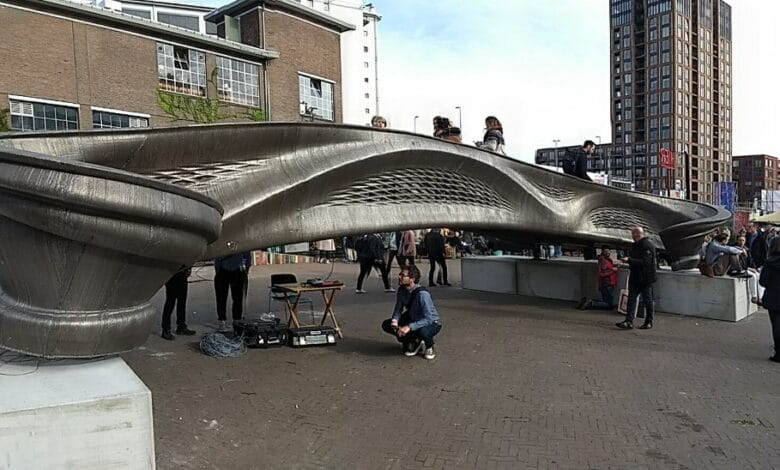
Across the globe, civil engineers are exploring a bold frontier: 3D-printed steel bridges that promise not only durability but also remarkable design flexibility and efficiency. Early real-world implementations, such as the Amsterdam pedestrian bridge, have shifted additive manufacturing from experimental curiosity to functional infrastructure. Embedded sensors feed continuous data into a digital twin, a live computational model, offering unprecedented insight into structural behavior. Early results suggest these bridges can safely bear loads exceeding their original design specifications, hinting at a durable, adaptable future for infrastructure—though it remains essential to view these findings as preliminary.
Real‑World Deployment of 3D‑Printed Steel Bridges
Amsterdam Pedestrian Bridge Case Study
The world’s first 3D-printed stainless-steel bridge, spanning a canal in Amsterdam, exemplifies the transition from laboratory innovation to real-world application. Designed and built by MX3D, the bridge carries regular pedestrian traffic while undergoing continuous structural monitoring. Sensors embedded throughout the bridge measure strain, vibration, and displacement, sending real-time data to a digital twin model that simulates the bridge’s behavior under varying conditions.
Embedded sensors and digital twins transform bridges into living laboratories, providing insights impossible with traditional inspection alone.
Testing revealed that the bridge could withstand loads far exceeding design expectations. The structure demonstrated resilience during peak pedestrian usage, confirming that 3D-printed steel bridges are not merely feasible-they are practical. Additionally, the design optimizes material placement, reducing overall weight while maintaining structural integrity.
Lessons for Global Infrastructure
While the Amsterdam bridge remains pedestrian-scale, its performance suggests potential for larger infrastructure. The combination of 3D printing and embedded monitoring systems could reshape future bridge construction. Engineers anticipate that, as fabrication techniques and regulatory frameworks advance, similar structures could be implemented for vehicular traffic. In addition, continuous monitoring promises fewer surprises, lower maintenance costs, and a longer lifespan compared with conventional bridges.
3D printing allows engineers to place steel only where it’s needed, making bridges lighter, more efficient, and potentially more sustainable than traditional methods.
Additive Manufacturing: Layer-by-Layer Steel Construction
Wire Arc Additive Manufacturing (WAAM) Techniques
At the heart of these innovative bridges lies Wire Arc Additive Manufacturing (WAAM), a process in which robotic welders deposit steel layer by layer. This technique allows precise material placement, reducing unnecessary weight without compromising strength. The resulting components meet conventional steel standards, with yield strengths around 355 MPa. Unlike traditional welding or casting, WAAM can produce complex geometries that would otherwise be costly or impossible to fabricate.
Design Flexibility and Structural Optimization
3D modeling optimizes load distribution and structural efficiency, enabling novel bridge geometries. Designs that were previously infeasible—such as curved pedestrian spans or lattice frameworks—are now realizable. Digital simulations verify performance prior to construction, ensuring safety while minimizing material use. The combination of structural integrity and design freedom exemplifies the promise of additive manufacturing for civil engineering.
With 3D printing, bridges can adopt complex forms once considered impractical, maintaining strength while cutting material use.
Structural Health Monitoring & Digital Twins
Sensor Integration and Real-Time Data Collection
Modern 3D-printed bridges incorporate networks of sensors embedded in steel components. Strain gauges, accelerometers, and displacement sensors track performance under daily load cycles. The real-time data feeds a digital twin, a dynamic computational model that mirrors the physical bridge. This integration allows engineers to track performance continuously, providing insights that traditional periodic inspections cannot match.
Predictive Maintenance and Lifecycle Advantages
The predictive power of digital twins offers early detection of wear or stress points. By simulating structural responses to hypothetical scenarios, engineers can schedule proactive maintenance before critical issues arise. This approach extends service life, reduces emergency repairs, and supports sustainable infrastructure planning.
Digital twins allow bridges to ‘tell’ us when maintenance is needed, rather than waiting for visible damage to appear.
Performance Comparison with Traditional Steel Bridges
Load-Bearing and Durability Metrics
Comparative studies indicate that 3D-printed steel bridges meet or exceed the load-bearing capacities of conventional welded or cast steel bridges. In practical terms, this means a pedestrian bridge that would traditionally require heavy, uniform beams can now be lighter, yet equally resilient, thanks to additive manufacturing and precise digital design.
Efficiency, Weight, and Resource Utilization
3D printing minimizes steel usage by placing material solely where needed, cutting weight by up to 30% in some cases. This efficiency not only reduces material costs but also decreases the environmental footprint of bridge construction, contributing to sustainability goals.
Limitations and Future Directions
While results are promising, the technology remains in early stages:
- Limited long-term performance data for large-scale or vehicular bridges.
- Variability in material properties across different printing sites.
- Regulatory standards for additive manufacturing in infrastructure are still developing.
The convergence of 3D printing, digital modeling, and sensor networks hints at a future where bridges are smarter, lighter, and longer-lasting than ever before.
Future studies will explore scaling bridges for heavier loads, integrating AI-driven predictive monitoring, and evaluating life-cycle sustainability metrics. The goal is not only to prove durability but to redefine infrastructure efficiency and adaptability.
Conclusion
3D-printed steel bridges are reshaping civil engineering. Early deployments demonstrate that additive manufacturing, coupled with embedded sensors and digital twins, can produce structures that are durable, efficient, and intelligently monitored. While long-term studies are ongoing, early evidence indicates that these bridges may set a new standard for sustainable, adaptive infrastructure.
Sources
- Cambridge Engineering: Structural monitoring and digital twin deployment
- Alan Turing Institute: Digital twin world-first bridge research
- Turing News: World-first 3D-printed steel smart bridge opens
- Civil Research Journals: WAAM steel bridge structural performance
- BMTPC: Digital twin in structural health monitoring
Disclaimer
Some aspects of the webpage preparation workflow may be informed or enhanced through the use of artificial intelligence technologies. While every effort is made to ensure accuracy and clarity, readers are encouraged to consult primary sources for verification. External links are provided for convenience, and Honores is not responsible for their content or any consequences arising from their use.
Image attribution
IIVQ / Tijmen Stam, CC BY-SA 4.0, via Wikimedia Commons