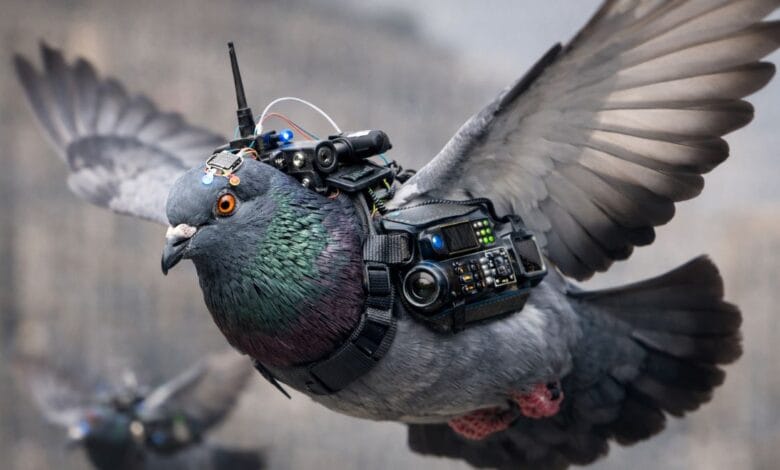
Watching birds soar through the open sky feels calming and fascinating. Pigeons, in particular, have played a unique role in human history. From ancient Egypt, Rome to World War II humans used homing pigeons to carry messages for thousands of years. In a surprising twist, during World War II, the United States experimented with using pigeons to guide missiles. Although the program was never used in combat, it showed the extraordinary abilities of pigeons. In recent years, pigeons and other birds have appeared in modern spying operations, carrying small cameras or tracking devices. But there has always been one limit: people could not fully control where the birds flew. Now, a company in Russia says it has found a way to guide pigeons’ flight using tiny devices attached to the birds and small implants in their brains. The company says the birds wear small backpacks with cameras and GPS units, and that operators can influence their flight paths. These claims come from the company’s announcements and news reports. Independent scientists have not verified the results.
The company, called Neiry Group, says it is creating what it calls “bio-drones.” According to the company, the project involves implanting small electrodes into pigeons’ brains. The electrodes are connected to a small stimulator on the bird’s head and to a backpack containing electronics, a GPS tracker, and a camera. The backpack is powered by solar energy, which the company says allows the birds to fly without stopping for recharging. Operators can send signals to the electrodes, which the company says stimulate brain circuits related to navigation. This is claimed to help guide the birds during flight. The company has shared photos and videos showing pigeons wearing the backpacks and flying through city and open environments. The birds are reported to fly hundreds of kilometers in a single day while streaming video back to operators. Neiry Group suggests that these pigeons could be used for inspecting infrastructure such as pipelines and power lines, supporting search and rescue missions, and monitoring areas where traditional drones may not fit. Pigeons’ natural flight endurance and ability to navigate urban landscapes are cited as advantages. Much of the information about the project comes from the company’s press releases and news articles. There are no peer-reviewed studies or independent tests that confirm the birds can be reliably controlled using these implants. Details about how many birds were tested, how often the system worked, or whether the birds experienced any harm are not available. The company’s reports focus on milestones rather than experimental data.
Laboratory research in neuroscience shows that electrodes and brain-computer interfaces can influence movement in controlled experiments. For example, scientists have used microelectrode arrays in rodents and other animals to make them move in specific directions or perform simple actions. These experiments are done in controlled settings with careful monitoring and safety measures. The goal of such studies is to understand how brains control movement and to explore possible medical applications. Controlling complex behaviors in free-flying animals, such as guiding pigeons in real-world environments, is much more difficult and has not been independently demonstrated. Experts outside the company have raised questions about the feasibility and ethics of guiding birds using brain implants. Birds rely on multiple senses and instincts to navigate, avoid obstacles, and react to weather. Electrical stimulation alone may not reliably produce the desired flight direction. Implanting electrodes into a bird’s brain is invasive, and animal welfare rules generally require clear scientific justification, minimization of suffering, and review by independent ethics committees. Neiry Group has not published details about how the birds’ welfare is monitored or how long-term effects are assessed.
The potential applications proposed by the company remain hypothetical. Neiry Group has suggested that bio-drones could be used for civilian purposes like infrastructure monitoring, search and rescue support, and urban surveillance. The company claims that living birds have advantages over mechanical drones because of their flight endurance and ability to reach tight or complex spaces. Even if the technology worked as described, challenges remain in ensuring predictable behavior, durability of the implants, and compliance with animal welfare standards.
From a scientific perspective, brain-computer interfaces have succeeded in laboratory settings for basic motor tasks, such as controlling robotic limbs or computer cursors using neural signals. Translating these methods to free-flying birds with complex instincts is much more complicated. Reliable control would require integrating sensory input, motor control, and higher-level decision making, which has not been shown in public experiments. The company has not released data showing success rates, comparative performance, or long-term results for pigeons. International animal welfare standards emphasize that invasive experiments must have clear research goals and minimize harm. Using unverified methods on animals for surveillance or commercial purposes lacks transparency and prevents the scientific community from evaluating safety, reproducibility, or risk. Ethical concerns also arise when modifying behavior in sentient animals. While brain-computer interfaces in humans are being tested to restore function after neurological injuries, applying similar methods to animals raises questions about autonomy and consent that have not been addressed.
At this point, the claims that pigeons have been turned into living drones remain unverified beyond media reports and company statements. Independent assessment, peer-reviewed publication, and open disclosure of methods would be required for the broader scientific community to evaluate the project’s validity and safety. Until then, the technology remains speculative, and the story highlights questions about ethics, feasibility, and the limits of current neurotechnology.
FAQs on Russia’s Pigeon Bio-Drones
Q: What are pigeon bio‑drones and how do they work?
A: Pigeon bio‑drones are pigeons fitted with neural implants and small electronic backpacks that include a GPS, camera, and control system. The company behind them says operators can upload flight tasks and send electrical signals to the implants to influence the bird’s natural navigation instincts and guide its flight path.
Q: Why are pigeons used for this type of technology?
A: Pigeons are used because they fly long distances, navigate complex environments, and do not require battery swaps like mechanical drones. Neiry Group says these traits may make pigeons useful for monitoring tasks where conventional drones struggle.
Q: Has this tech been tested outside a lab?
A: Yes, Neiry Group’s early field tests with pigeons equipped with brain implants and backpacks have taken place in and around Moscow. These tests aim to assess flight performance and the ability to follow operator‑directed tasks.
Q: Can operators truly control where the pigeons fly?
A: The company claims that by stimulating specific brain areas with implanted electrodes, they can influence a pigeon’s motivation to turn or move in a chosen direction, effectively guiding its flight. Independent researchers have not yet verified these claims.
Q: What are the proposed uses for pigeon bio‑drones?
A: Neiry Group suggests pigeon bio‑drones could be used for monitoring infrastructure like power lines, inspecting industrial facilities, assisting in search and rescue operations, and gathering aerial data in areas where traditional drones may not be practical.
Q: Are there safety or ethical concerns with brain implants in animals?
A: Yes. Scientists and animal welfare experts have raised concerns because invasive brain implants involve surgery and potential harm to the animals. Ethical rules for animal research typically require evidence of benefit, pain reduction, and independent review, none of which have been published for this specific project yet.
Q: How far can these pigeon bio‑drones fly?
A: Neiry Group claims a single pigeon equipped with their system can fly about 180 to 300 miles (around 300 to 480 kilometers) in a day, powered by solar energy on its backpack. However, these figures are based on company statements and not independent research.
Q: Could this technology be used for spying or military purposes?
A: Experts warn that even if the pigeon bio‑drone technology works as claimed, it could be repurposed for covert surveillance or military use, though such applications also raise additional ethical and legal concerns.
Q: Are there scientific studies showing pigeons can be controlled this way?
A: No peer‑reviewed scientific studies have been published confirming that pigeons can be reliably controlled in flight using brain implants. Reports about the technology come mainly from the company and news articles, not from independent scientific evaluation.