Key Takeaways
- The study links cold exposure and longevity through molecular pathway.
- Cold raises BH2 levels in worms through the CAT-4 enzyme.
- BH2 travels from muscle to distant tissues, including intestine and neurons.
- Increasing BH2 synthesis in muscle extended lifespan even without cold exposure.
- BH2 or tyrosine reduced protein clumping in cultured human cell models.
Understanding why organisms age, and whether the process can be slowed, remains a central question in biological research. In a lab in Cologne, researchers found that microscopic worms live longer when exposed to moderately lower temperatures. The explanation lies not simply in the cold itself, but in a small molecule produced by muscle tissue that helps protect cells from age-related damage. How can a change in temperature trigger a process that influences lifespan and keeps proteins healthy?
A study published in Nature by researchers at the University of Cologne sheds light on this connection. It examines the relationship between temperature, molecular activity and aging, bringing a fresh perspective to how environmental conditions interact with biological processes. To understand what makes this connection significant, we need to look more closely at the research and the mechanisms the scientists set out to investigate.
Why Does Mild Cold Extend Lifespan?
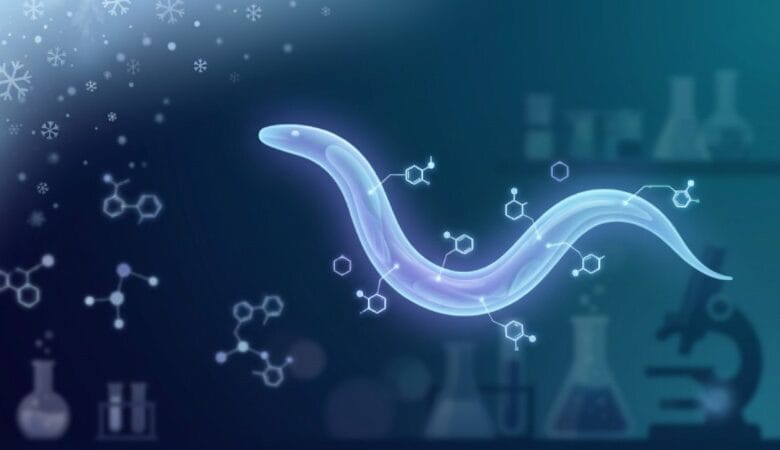
Cold temperature reliably extends lifespan in Caenorhabditis elegans, the millimeter-long nematode that anchors this study. Moving adult worms from 20 degrees Celsius to 15 degrees Celsius lengthens survival, and comparable effects appear across other species. Scientists have documented this pattern for over a century, yet the molecular mechanism remained unresolved.
A colder animal slows its metabolism, alters energy handling, and reshapes its chemistry in thousands of ways simultaneously. Identifying which single change actually causes longer life is like finding one instrument in an orchestra. The study, published in Nature on 21 October 2026 by Lee HJ, and colleagues at the University of Cologne, approached the problem as a signal-tracing exercise. The researchers reasoned that if cold sends a message across the whole body, a small mobile molecule, a metabolite, might act as the courier. The finding gives researchers a concrete molecular explanation for how cold exposure and longevity are connected, at least in worms.
How Does Cold Switch On the BH2 Pathway?
The study identifies a metabolite-driven, multi-tissue pathway that connects cold exposure to longevity and proteostasis, the cellular system that keeps proteins correctly folded and clears damaged ones. The central molecule is BH2, also called dihydrobiopterin, a member of the pterin family of small molecules.
The researchers ran untargeted metabolomics screens, chemical surveys that quantify hundreds of metabolites at once, on adult worms kept at different temperatures. Two independent experiments, each with five biological replicates and a false discovery rate threshold of q < 0.01, converged on the same result: BH2 levels rose in worms held at 15 degrees Celsius. A genetic control sharpened the picture. In trpa-1(ok999) mutant worms, which lack a functional version of TRPA-1, a cold-sensing channel protein, cold failed to raise BH2 the way it did in normal animals.
BH2 matters because of what it becomes. According to the study’s proposed mechanism, cold activates CAT-4, an enzyme required for pterin production, and the resulting BH2 is synthesized in muscle. From muscle, BH2 travels to distant tissues, including the intestine and neurons. There, the enzyme DHFR-1 converts BH2 into BH4, or tetrahydrobiopterin, a cofactor that enables phenylalanine hydroxylase, or PAH-1, to produce the amino acid tyrosine. One detail makes the worm’s version of this pathway especially distinct: C. elegans lacks sepiapterin reductase, an enzyme mammals use to synthesize BH4, so the BH2 route carries unusual weight in this organism.
What is the Evidence, and What Does it Mean for Humans?
The strongest evidence that this pathway causes longevity comes from a targeted genetic experiment. The researchers engineered worms whose CAT-4 enzyme could be degraded on command, but only after development was complete, because CAT-4 is required for normal growth. In adult worms, losing CAT-4 erased much of the cold benefit, and the effect was sharply temperature specific. At 15 degrees Celsius, the depleted worms died significantly earlier. At 20 degrees Celsius, their survival matched normal worms. Each condition used 96 worms, and the lifespan data were representative of two independent experiments.
The study also reports that increasing BH2 synthesis specifically in muscle extended lifespan and reduced protein aggregation even without cold, which positions BH2 as a causal node rather than a passive marker. On the other side, treatment with BH2 or tyrosine reduced both the aggregated and total amounts of Q74, a fragment of the human huntingtin protein, in worms under paraquat-induced oxidative stress. The study further reports that BH2 or tyrosine supplementation decreased aggregation of disease-related proteins in cultured human cell models.
Translational boundaries remain firm, and this is where we should take pause. Every finding of this study comes from an invertebrate at a laboratory growth temperature, not from mammals experiencing environmental cold. Worms and mammals build BH4 with partly different enzyme toolkits. The human data come from cell culture, which demonstrates that the downstream chemistry can operate in human cells, but says nothing about dosing, tissue delivery, or safety in living people. The study establishes a candidate mechanism in C. elegans and a testable hypothesis for human aging research. The logical next step, which the evidence itself points toward, is testing whether a muscle-derived BH2 network responds to cooling in a mammalian models such as mouse.
FAQs on Cold Exposure and Longevity
Q: Is there a link between cold exposure and longevity?
A: A new study found that worms lived longer when kept at a cooler temperature, and researchers traced exactly how the cold did it. The catch is that this happened in worms, not on humans. So future studies are needed to find the evidence that cold exposure extends human lifespan.
Q: What is the BH2 pathway and how does cold activate it?
A: BH2 is a tiny molecule that acts like a messenger inside the body. Scientists discovered that when worms get cold, this molecule ramps up, travels from muscle to other organs, and helps the body keep its cells healthy, which appears to be one reason the worms lived longer.
Q: How does feeling cold turn into a longer life inside the body?
A: In the study, cold switched on a specific enzyme in the worms’ muscles, which increased BH2. That molecule then moved to distant tissues and was converted into another substance that helps make tyrosine, a building block the body needs to keep proteins from clumping together as animals age.
Q: What is protein clumping and why does it matter as we age?
A: As cells get older, proteins inside them can misfold and stick together in clumps, and this buildup is linked to aging and diseases like Huntington’s. In this study, treating cells with BH2 or tyrosine reduced that clumping, which suggests this cold-triggered pathway helps cells keep up their protein housekeeping.
Q: Why did the researchers use worms instead of mice or humans?
A: Caenorhabditis elegans lives only a few weeks, which makes lifespan experiments fast and statistically practical, and its genetics can be manipulated with precision. The tradeoff is translational: worms and mammals build BH4 with partly different enzyme sets, so results in worms do not transfer automatically to humans.
Q: Did scientists test this on Humans?
A: Only partly. The main experiments were done in worms, but the researchers also added BH2 or tyrosine to human cells in a lab dish and saw less protein clumping, which is a promising early sign. No living person took part, so we do not know if any of this works in the human body.
Q: Does this study prove that ice baths or cold showers extend lifespan?
A: No. The study exposed worms to a constant growth temperature of 15 degrees Celsius, which is a laboratory condition, not a cold plunge or a shower. Human cold exposure involves shivering, brown fat activation, and cardiovascular stress that have no equivalent in this worm model.
Q: Should I take BH2 or tyrosine supplements for longevity?
A: The study tested BH2 and tyrosine in worms and in cultured cells, not in Humans. There are no human safety or efficacy data for this use, and the study does not support taking supplements. Anyone considering supplements should consult a physician.
Q: What is proteostasis and why does it matter for aging?
A: Proteostasis is the cellular system that keeps proteins folded correctly and clears damaged or clumped ones, and it weakens as cells age. In the study, BH2 or tyrosine treatment reduced the aggregated and total amounts of Q74, a fragment of the human huntingtin protein, in worms under oxidative stress, indicating the pathway supports protein quality control.
Q: How strong is the evidence that BH2 causes longer lifespan rather than just marking it?
A: The evidence is causal, not correlational. Two independent metabolomics experiments with five biological replicates each identified BH2, a genetic control confirmed cold raised BH2 through the TRPA-1 channel, removing CAT-4 removed the cold benefit, and raising BH2 synthesis in muscle alone extended lifespan and reduced protein aggregation without cold.
Q: What would it take for this research to apply to humans?
A: The logical next step is testing whether a muscle-derived BH2 network responds to cooling in a mammal such as a mouse, followed by measuring pterin metabolism in people exposed to cold. Until such studies exist, the worm findings represent a candidate mechanism and a testable hypothesis for human aging research, not an established human finding. Until such studies exist, the worm findings are a molecular clue about cold exposure and longevity, not an established human finding.
References
Disclaimer:
Some aspects of the preparation of this content may be assisted by artificial intelligence or automated technologies and are subject to human editorial review and source verification. Readers are encouraged to consult the original research and primary sources for complete context. External links are provided for convenience, and TheHonores does not control or endorse their content. Relevant conflicts of interest, funding, sponsorship, or other disclosures are identified where applicable. This content is for informational purposes only and is not professional or medical advice. Images are for illustrative or representational purposes unless otherwise stated.