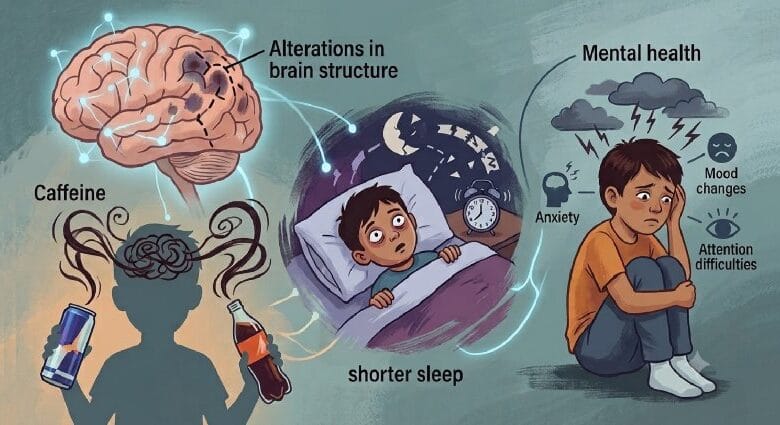
A soft drink after school or a cup of coffee may seem like an ordinary part of childhood. But could these everyday caffeine habits be associated with how long children sleep, differences in their developing brains, and their mental health months later? To investigate this, researchers examined data from more than 9,600 children aged 9 to 11, looking for connections between caffeine consumption, sleep duration, brain structure and later mental health symptoms.
A recently published study found that higher caffeine consumption was associated with shorter sleep and differences in brain structure, while statistical analyses identified pathways connecting these patterns with later mental health symptoms. However, the findings varied by beverage type, and an independent expert described the observed brain differences as very small. What do these results reveal about children’s caffeine habits, and how much do they matter for their health?
How is Caffeine Consumption associated with Children’s Brain Structure?
Higher reported caffeine consumption was associated with lower total cortical surface area in children aged 9 to 11, according to a 2026 study published in Biological Psychiatry: Cognitive Neuroscience and Neuroimaging. Researchers Jiayi Zheng and Divyangana Rakesh analysed data from 9,632 children in the US Adolescent Brain Cognitive Development (ABCD) Study. They compared reported caffeine consumption with brain measurements obtained using structural magnetic resonance imaging (MRI).
The cerebral cortex is the brain’s outer layer. Cortical surface area measures the extent of this layer, while cortical thickness measures how thick its tissue is. These measurements describe different features of brain structure. The researchers found that higher total caffeine intake was associated with lower total cortical surface area. They also identified associations in 22 brain regions across four lobes. Average cortical thickness was not significantly associated with total caffeine intake. Other research has explored the relationship between coffee consumption and brain ageing.
The results varied by beverage. Soft drink consumption accounted for much of the association with lower total and regional cortical surface area. Coffee and espresso consumption were associated with average cortical thickness and measurements in some frontal brain regions. Tea consumption was not significantly associated with the global or regional brain measurements examined. Caffeine’s effects have also been studied in relation to cardiovascular health, including whether coffee raises blood pressure.
These findings show associations between reported caffeine consumption and brain measurements. They do not establish that caffeine caused structural changes or that the differences were harmful. In commentary published by the Science Media Centre, Dr Rallis described the brain differences as very small and the association with later mental health as negligible.
What Role does Sleep Play in the Relationship Between Caffeine and Mental Health?
The researchers’ statistical analyses identified sleep duration as a possible link between caffeine consumption, brain structure and later mental health symptoms. The study assessed children’s reported consumption of coffee or espresso, tea and caffeinated soft drinks. Researchers also examined sleep duration and mental health symptoms reported at six and 18 months. The children’s average reported sleep duration was 9.06 hours. Sleep duration is also relevant to wider health concerns, as explored in our article on insufficient sleep among US adults.
Higher caffeine consumption was associated with shorter sleep duration. Statistical models indicated that sleep duration partly accounted for the association between total caffeine intake and cortical surface area, particularly for total caffeine consumption and soft drinks. The researchers also tested whether sleep duration and cortical surface area could help explain the association between caffeine intake and mental health symptoms at later follow-ups.
At six months, the analysis identified a statistical pathway linking higher caffeine consumption with more mental health problems through shorter sleep and lower cortical surface area. At 18 months, the pathway involving total cortical surface area remained statistically significant, but the pathway involving regional surface area did not.
The findings point to a possible connection between caffeine consumption, sleep and children’s mental health. Shorter sleep duration and differences in cortical surface area emerged as potential links between caffeine intake and mental health symptoms reported months later. These relationships give researchers a basis for further investigating how children’s caffeine habits relate to sleep and brain development. Soft drinks accounted for much of the association with lower cortical surface area. Since soft drinks also contain sugar, further research can help clarify how caffeine and other aspects of beverage consumption contribute to these observed patterns. Related research has also examined the link between sugary drinks and anxiety in teenagers.
What Do the Findings Tell Us About Caffeine and Children’s Health?
The findings suggest that children’s caffeine consumption, sleep duration and brain structure are related in ways that researchers can investigate further. However, the size of the observed brain differences matters when considering their potential significance for children’s health.
Dr Charalampos Rallis described the brain differences as very small and the association with later mental health as negligible. This assessment puts the findings into perspective: the study identified measurable associations, but their implications for children’s development remain unclear.
The results also highlight the need to examine different sources of caffeine separately. Because soft drinks accounted for much of the association with lower cortical surface area, researchers need to clarify how caffeine, sugar and other factors related to beverage consumption contribute to the observed patterns.
FAQs on Caffeine Consumption associated with Children’s Brain Structure
Q: What does the study say about caffeine consumption in children?
A: A 2026 study of 9,632 children aged 9 to 11 found that higher reported caffeine consumption was associated with lower total cortical surface area, shorter sleep duration and later mental health symptoms. The study identified associations but did not prove that caffeine caused these outcomes.


Q: Can caffeine affect brain development in children?
A: The study found associations between caffeine consumption and certain brain structure measurements, particularly cortical surface area. However, it did not establish that caffeine caused changes in brain development or that the observed differences were harmful.
Q: How does caffeine consumption affect sleep and mental health in children?
A: Higher reported caffeine consumption was associated with shorter sleep duration and later mental health symptoms. Statistical analyses suggested that sleep and cortical surface area might help explain these relationships, but the study did not establish a causal link.
Q: Which drinks were associated with differences in children’s brain structure?
A: Soft drink consumption accounted for much of the association between caffeine intake and lower cortical surface area. Coffee and espresso consumption showed associations with some cortical thickness measurements, while tea consumption was not significantly associated with the brain measurements examined.
Q: Is one cup of caffeine per week harmful to children?
A: The study reported some associations at consumption levels as low as one cup per week, but this was an exploratory finding, not an established harmful dose. The researchers measured consumption in cups rather than precise caffeine doses, and different beverages contain different amounts of caffeine.
Q: Are the brain structure differences linked to caffeine large or significant?
A: The independent expert commentary cited in the article described the observed brain differences as very small and the association with later mental health as negligible. Statistical significance does not necessarily mean that a finding has a substantial effect on children’s health.
Q: Does caffeine cause mental health problems in children?
A: The study does not show that caffeine causes mental health problems. It found statistical associations between reported caffeine consumption and later mental health symptoms, with sleep duration and cortical surface area emerging as possible links in the analysis.
Q: Is caffeine in soft drinks more concerning than caffeine in tea or coffee for children?
A: The study found different patterns across beverage types, with soft drinks accounting for much of the association with lower cortical surface area. However, the researchers could not determine whether caffeine itself, sugar, or other dietary and lifestyle factors explained the differences.
Q: How many children were included in the caffeine and brain structure study?
A: The researchers analysed data from 9,632 children aged 9 to 11 participating in the US Adolescent Brain Cognitive Development (ABCD) Study. They examined reported caffeine consumption, structural MRI measurements, sleep duration and mental health symptoms at later follow-ups.
Q: What are the limitations of the research on caffeine and children’s mental health?
A: The study identified associations rather than proving cause and effect. Caffeine intake was reported in cups rather than precise doses, and factors such as sugar consumption and other lifestyle behaviours could have influenced the findings. Further research is needed to determine whether the observed brain differences have meaningful effects on children’s health.
References
- Zheng J, Rakesh D. Caffeine Consumption and Adolescent Mental Health: The Role of Sleep and Brain Structure. Biological Psychiatry: Cognitive Neuroscience and Neuroimaging. 2026 Oct 15. In Press. DOI: 10.1016/j.bpsc.2026.09.011.
- Watson EJ, Banks S, Coates AM, Kohler MJ. The relationship between caffeine, sleep, and behavior in children. Journal of Clinical Sleep Medicine. 2017 Apr 15;13(4):533-43. Doi: 10.5664/jcsm.6536.
- Hill D, Rallis C. Expert reaction to observational study on caffeine consumption in adolescents, sleep and brain structure. Science Media Centre. October 15, 2026. Available from: https://www.sciencemediacentre.org/expert-reaction-to-observational-study-on-caffeine-consumption-in-adolescents-sleep-and-brain-structure/
Disclaimer:
Some aspects of the preparation of this content may be assisted by artificial intelligence or automated technologies and are subject to human editorial review and source verification. Readers are encouraged to consult the original research and primary sources for complete context. External links are provided for convenience, and TheHonores does not control or endorse their content. Relevant conflicts of interest, funding, sponsorship, or other disclosures are identified where applicable. This content is for informational purposes only and is not professional or medical advice. Images are for illustrative or representational purposes unless otherwise stated.