Key Takeaways
- A mixture of three bisphenols altered human breast tissue development in laboratory experiments.
- Researchers identified molecular patterns associated with breast cancer in treated breast tissue.
- The study examined combined effects of three widely used industrial chemicals.
- The findings provide evidence about how chemical mixtures affect human breast tissue development.
What happens when chemicals encountered in everyday life interact with human breast tissue in ways that researchers can observe but cannot yet fully explain? In a laboratory study, scientists found that a mixture of three widely used industrial chemicals altered human breast tissue development and produced molecular patterns associated with breast cancer. The findings reveal a more complex picture of how chemical exposures may affect developing tissue, raising an important question: what can laboratory evidence tell us about the potential health effects of chemical mixtures?
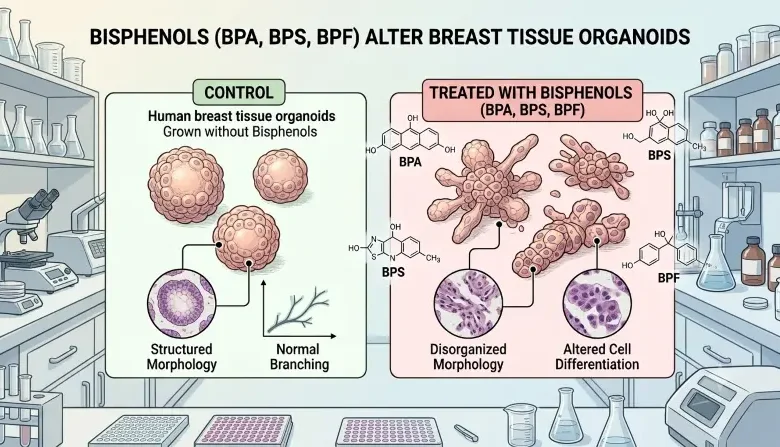
A study published in Proceedings of the National Academy of Sciences (PNAS) found that a mixture of three widely used industrial chemicals (bisphenols) altered human breast tissue development in the laboratory. The researchers also identified molecular patterns associated with breast cancer. Together, these findings provide new insights into how chemicals especially bisphenols may influence breast tissue development and the molecular processes linked to breast cancer.
What Are Bisphenols, Where Are They Found, and How Are People Exposed?
Bisphenols are industrial chemicals used to manufacture plastics, resins and other materials. Bisphenol A (BPA) is used in some polycarbonate plastics and epoxy resins, while bisphenol S (BPS) and bisphenol F (BPF) are related compounds used in certain applications. These chemicals can be found in some food containers, the linings of certain food cans and thermal paper receipts. People may encounter them through food and beverages, contact with contaminated dust and other environmental sources. Exposure routes vary depending on the chemical and the surrounding environment. Research into consumer products has also examined the presence of toxic chemicals in headphones.
Some bisphenols can interfere with the endocrine system, which regulates hormones and other important bodily functions. Researchers have investigated their potential effects on reproduction, development and other biological processes. However, the evidence varies by chemical and health outcome. An effect observed in a laboratory experiment does not automatically establish harm at typical human exposure levels.
How did BPA, BPS and BPF affect human breast tissue development?
Researchers led by Charlotte Kuperwasser at Tufts University examined how a mixture of BPA, BPS and BPF affected human breast organoids. Organoids are three-dimensional structures grown from cells that reproduce selected features of tissue organization.
The researchers exposed organoids derived from multiple donors to a mixture containing 5 nanomolar of each bisphenol for 21 days. The mixture disrupted organoid development across the six donor samples. Five of the six samples showed fewer organoids than their controls, and the researchers observed structural changes, including premature lobule formation.
When tested individually at the same concentration in the corresponding experiment, none of the three chemicals produced a statistically significant developmental effect. The mixture did. This result suggests that examining chemicals individually may not capture every effect that can occur when they are combined under the same experimental conditions. However, the findings demonstrate an effect in the laboratory model, not a confirmed response in people.
Why did researchers compare the molecular changes with breast cancer?
To investigate the biological changes associated with exposure, the researchers examined gene expression and DNA methylation. Gene expression describes how cells use genetic information, while DNA methylation is a chemical modification involved in regulating gene activity. RNA sequencing identified 712 genes with increased expression and 469 with decreased expression following exposure. The researchers also found changes in biological processes related to tissue organization and cellular identity.
They then compared the molecular signatures with human breast cancer datasets. The gene expression pattern showed stronger associations with estrogen receptor positive luminal breast cancers than with basal cancers. The researchers also reported enrichment of the gene expression signature in invasive lobular carcinoma compared with invasive ductal carcinoma.
The DNA methylation analysis revealed a more complex pattern. When the researchers compared 784 primary breast tumors with 97 adjacent-normal tissue samples, the exposure-associated methylation signature had lower scores in tumors than in adjacent-normal tissue. However, the signature was enriched in invasive lobular carcinoma compared with invasive ductal carcinoma in the tumor-subtype analysis. These findings describe different comparisons and should not be interpreted as evidence that the signature was consistently elevated in cancer tissue. These molecular similarities identify patterns worth further investigation.
Beyond chemical exposures, researchers have also investigated whether biological factors may contribute to breast cancer development. Explore the research on whether bacteria can cause breast cancer.
What do these findings mean for human breast cancer risk?
Bisphenols are part of a broader discussion about the chemicals associated with plastic production and use, and how people may be exposed to them in everyday life. For a wider look at this issue, explore the health impacts of rising plastic use.
The study links three observations: the bisphenol mixture disrupted breast organoid development, exposure altered molecular patterns, and some of those patterns resembled signatures found in human breast cancer datasets.
The study provides laboratory evidence of how BPA, BPS and BPF may influence breast tissue development. Further research can help determine whether these changes are associated with breast cancer risk in humans over time.


The main mixture experiment involved six donors, and individual responses varied. The organoid model also cannot reproduce every feature of a living breast. Further research is needed to determine whether the observed changes persist after exposure ends and whether they have lasting consequences for tissue function.
The study therefore provides evidence that a mixture of three bisphenols can alter human breast organoid development and produce molecular patterns associated with breast cancer under laboratory conditions. Whether these changes translate into an increased risk of breast cancer in humans remains unknown.
Frequently Asked Questions on Bisphenols and Breast Cancer
Q: Can bisphenols like BPA, BPS and BPF cause breast cancer?
A: The PNAS study found that a mixture of BPA, BPS and BPF disrupted human breast organoid development and produced molecular patterns associated with breast cancer. However, it did not establish that these chemicals cause breast cancer in humans. Further research is needed to determine whether the laboratory findings translate into increased cancer risk.
Q: What did the 2026 PNAS study find about bisphenols and breast tissue?
A: Researchers found that a mixture of BPA, BPS and BPF disrupted breast organoid development during a 21-day laboratory experiment. Five of the six donor samples showed fewer organoids than their controls, and the researchers identified changes in gene expression and DNA methylation.
Q: What is the difference between BPA, BPS and BPF?
A: BPA, BPS and BPF are related industrial chemicals used in certain plastics, resins and other applications. BPS and BPF are alternatives to BPA in some uses, but they are not necessarily biologically equivalent. Their effects can vary depending on the chemical, concentration and exposure conditions.
Q: Where are bisphenols found in everyday products?
A: Bisphenols can occur in certain food containers, epoxy linings used in some food cans and thermal paper receipts. The specific products containing these chemicals vary, and not every plastic container or receipt contains bisphenols.
Q: How do bisphenols enter the human body?
A: People may be exposed to bisphenols through food and beverages, contact with contaminated dust and other environmental sources. The relative importance of each exposure route depends on the chemical and the circumstances.
Q: Are BPS and BPF safer than BPA?
A: Replacing BPA with BPS or BPF does not automatically establish that a product is safer. These chemicals have different properties, and their potential health effects must be evaluated individually and under relevant exposure conditions. The PNAS study examined a mixture of all three, so it does not establish that BPS or BPF alone causes breast cancer.
Q: What are breast organoids, and why did scientists use them?
A: Breast organoids are three-dimensional structures grown from cells that reproduce selected features of human breast tissue. They allow researchers to investigate how chemicals affect tissue development and cellular activity under controlled laboratory conditions, but they cannot reproduce every feature of a living human body.
Q: Does the bisphenol study prove that everyday chemical exposure increases breast cancer risk?
A: No. The study identified developmental changes and molecular patterns associated with breast cancer in a laboratory model, but it did not track chemical exposure or subsequent cancer diagnoses in people. Establishing human cancer risk requires additional evidence.
Q: Can avoiding BPA reduce exposure to potentially harmful bisphenols?
A: Reducing contact with products known to contain BPA may help limit exposure to that chemical, but it does not necessarily eliminate exposure to related compounds such as BPS and BPF. The study does not establish how much any particular avoidance measure would change breast cancer risk.
References
- Parrish M, Seraj M, Nikoueian H, Traugh N, Chen A, Gupta PB, Monti S, Kuperwasser C. Environmental chemical mixtures reprogram mammary epithelial development to epigenetic states associated with breast cancer. Proc. Natl. Acad. Sci. U.S.A. 2026. 123 (42) e2613054123. Doi:10.1073/pnas.2613054123.
- Bousoumah R, Leso V, Iavicoli I, Huuskonen P, Viegas S, Porras SP, Santonen T, Frery N, Robert A, Ndaw S. Biomonitoring of occupational exposure to bisphenol A, bisphenol S and bisphenol F: A systematic review. Science of the Total Environment. 2021 Aug 20;783:146905. Doi: 10.1016/j.scitotenv.2021.146905.
Disclaimer:
Some aspects of the preparation of this content may be assisted by artificial intelligence or automated technologies and are subject to human editorial review and source verification. Readers are encouraged to consult the original research and primary sources for complete context. External links are provided for convenience, and TheHonores does not control or endorse their content. Relevant conflicts of interest, funding, sponsorship, or other disclosures are identified where applicable. This content is for informational purposes only and is not professional or medical advice. Images are for illustrative or representational purposes unless otherwise stated. Image generated using AI illustration tools.